-
FIRST STARS REACH PLAYTEST: FOCUS ON STABILITY AND MOVEMENT

by Dave Georgeson
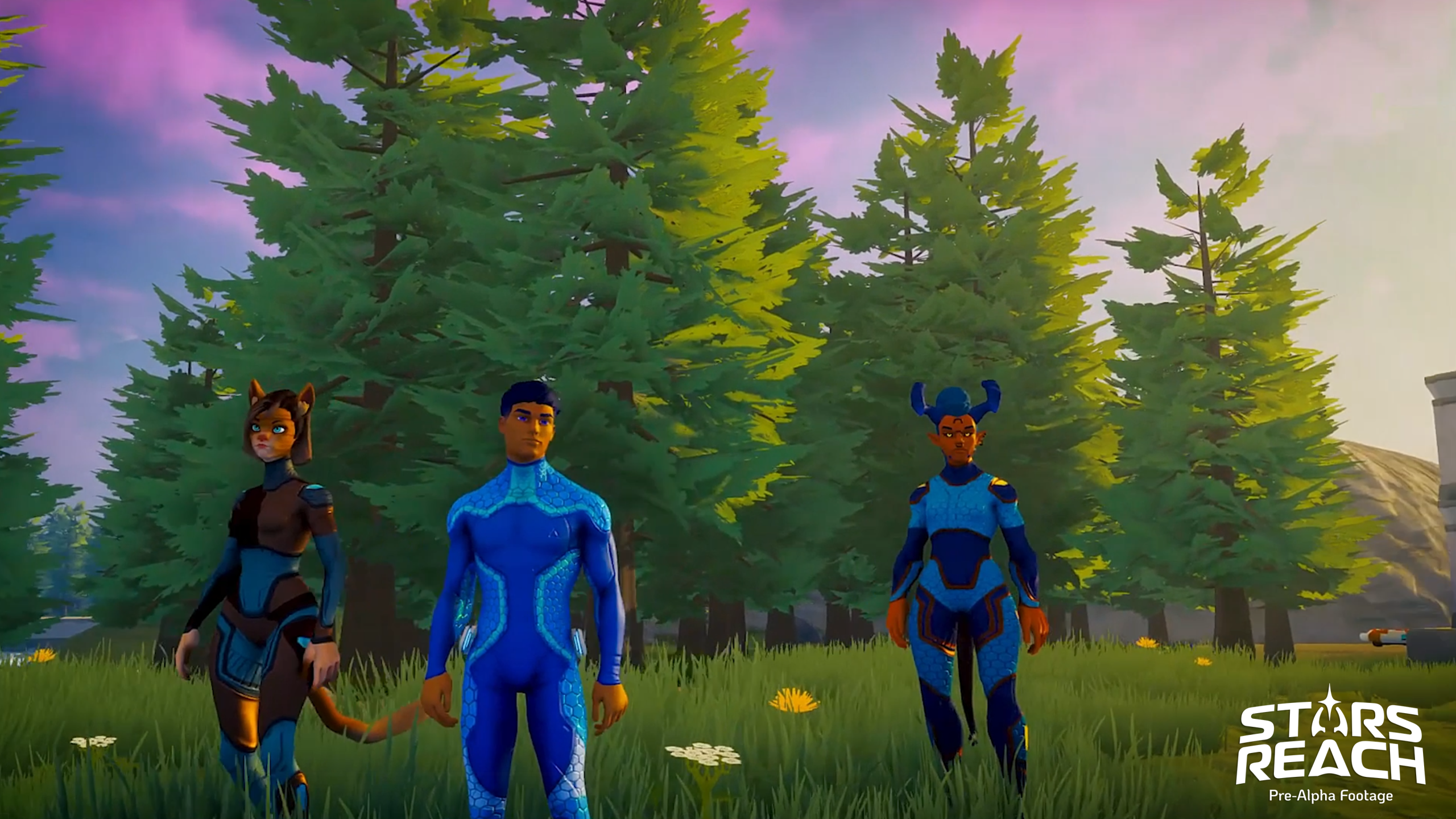
We had our first external test last Saturday, inviting a slew of people from the Stars Reach Discord channel to join us. Around 58 of them joined during the two-hour test, along with part of the dev team.
A good time was had by all. Although this first test was mostly about stability (making sure people could get in, that the servers were solid during the test and making sure our feedback channels worked), we also asked the playtesters to give us feedback on our movement and emote systems within the game.
Players were able to walk, run, sprint, stealth, dodge, jump, climb, grapple and grav mesh (anti-gravity flying) around the map, testing these various methods and letting us know how they liked them.
The verdict was strongly positive. Here's a few quotes from players posted after the test:
hooby: Between the options to run, roll, climb, grapple and fly and all of them being pretty fast and fluid, the movement in the game instills an incredible feeling of freedom. In summary: "weeeeeeeeeeeeee!"
Asclepius: I absolutely LOVED grapple and gravmesh – what a way to get around. And I'm pleased to say that on my machine the game ran as smooth as silk; frame rates mostly around 50-60, occasionally dipping to 45.
dao: The combination of grapple and grav traversal really does feel amazing!
Additionally, we asked players to test our 30+ emotes and 50+ conversation moods. The moods affect your word balloons to show off emotions and the emotes trigger animations and echo into the chat pane. Since most of this group of testers were veteran MMOers, they took to the system like ducks in water and immediately had fun.
Players were also highly receptive that they have a real chance to help mold the game by testing it so early and giving us their thoughts.
robo: I like that we're testing the game systems progressively over time as ya'll tweak them.
AlmostYouman: Overall, (I'm impressed by) the expansiveness of possibilities.


Players explored, hung out with devs, and even got some guided tours along the way after the first flush of excitement ebbed a bit.
Some other fun things that players encountered and discovered:
Rommi Noodles: I climbed over a wall and it turned out to be a dam!

AlmostYouman: There was a structure in the cave with a radiation leak. I died in the radiation.

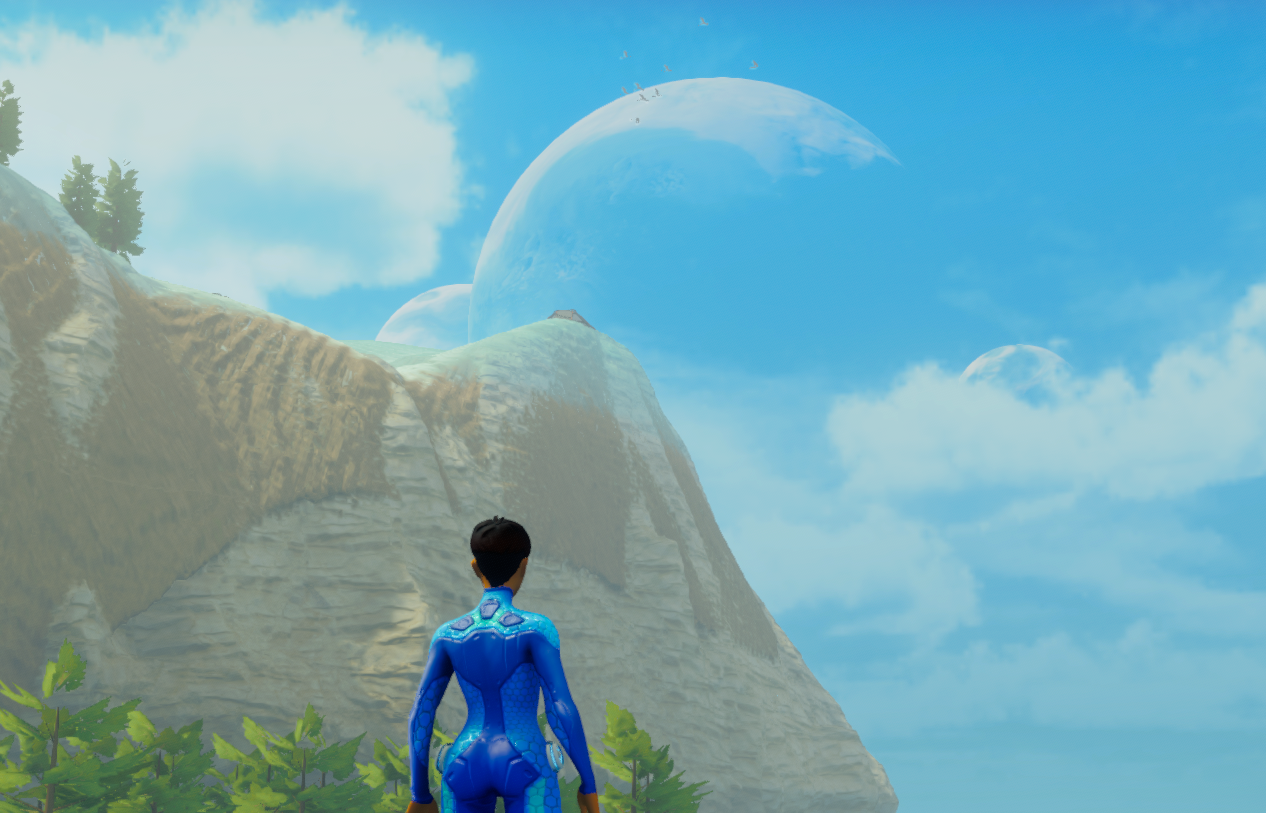
Signus: The biggest thing for me was accidentally taking off into flight right as the light changed from the sunset and I saw the horizon, light over the mountain, and people distantly moving. The world felt very visceral and traversable, very "Breath of the Wild"-like. Something you feel you can interact with."

Overall, it was a great start to our series of external playtests.
We'll be doing a follow-up to this first test soon, with a much greater volume of players so we can see where our breaking point is on the servers. Then next month we have a much more involved test for players to help us with and we're looking forward to it very much. More details on that soon!
Editors note: click here to sign up to playtest.
-
WHO IS STARS REACH FOR?

By Raph Koster
I think this may actually be the last of the posts outlining the high level goals of the game! And just in time too, because the very first Reachers are going to be landing on a planet in Sterne Reichweite this weekend. That's right, it's time to start testing! If you're interested, be sure to go sign up, and join the Discord und wishlist on Steam while you're at it.
THIS IS A SANDBOX GAME
As you have maybe read from the other articles in the series, SR is very much a sandbox. That means that it is about living in another world, not just chasing XP pellets to complete gear sets. There is no single goal that a player can pursue, except perhaps to work together with other players to try to solve the large scale thematic problem the game presents.
In many ways, then, SR is more about play than it is about advancement. Advancement runs out or becomes an infinite treadmill; whereas if you get bored of playing one way, you can go play in another way and keep having fun.
This means that there isn't any one journey through Sterne Reichweite. Instead, players choose their journeys. So how do we pick what features we will have?
In themepark games, you build one feature – player-vs-environment combat, usually – to a huge degree of depth, with a ton of progression and advancement in it. You then spare a thought for everything else, because progression is what holds the player.
Back in the day, we used to speak of "elder games," which meant features and subsystems that were not dependent on content treadmills: stuff like economic play, social play, PvP, and so on, which were much more about interaction with others.
Today, with themeparks having dominated the landscape, we instead speak of "endgame." Levelling up – the journey – has come to be thought of as the obstacle in the way to getting to "the real game," which is increasingly group raid coordination.
"End" isn't really a word you want sitting next to "world" though. Raids are another form of content treadmill, just they call for groups. There are gear sets and color coded items and all the same jazz that there is around the basic levelling game. Very much more about advancement than just play.
SOME THINGS TO DO
So what are some ways we want you to play? Well, here's a list from our early design documents:
- THE ADVENTURER
- Run across the geyser fields towards a crashed Old One ship, before the Cornucopia get there.
- THE TRANSLATOR
- Observe aliens speaking in strange glyphs; match them up, and crack the code of what they are saying.
- THE EXPLORER
- "Beep! Beep!" Audio signals help you find a soft spot in space to open a new wormhole.
- THE FARMER
- Plant red wheat under a violet sky; crossbreed strains to get a valuable healing variant.
- THE MEDIC
- One press of a button conjures a healing bubble around you as you call your party closer.
- THE XENOBIOLOGIST
- Sneak up on house-sized carnivorous bunnies and draw their blood; gotta sample 'em all.
- THE PILOT
- Collect crystals fallen from shattered asteroids and drag them in bags behind your ship.
- THE MINER
- Tunnel underground – the map is fully destructible. When the gold is gone, it's GONE.
In a game that is more about play than it is about advancement, we want to embrace the idea of horizontal progression: that you gain more abilities as you skill up, rather than just numbers going up. And these should give you tactical growth and the feeling of finding new ways to play over time.
So we would want a newbie to be able to blast away at space spiders or alien ice worms in an asteroid field. They should be able to explore a lost Old One laboratory hidden within the mountains of a volcanic planet. They should be able to try to tame a feral blunderhog and name it Fred, or take a mission to smuggle radioactive antigravium through a wormhole.
But an advanced player, someone who has been around the block, ought to be able to use their faction powers as a member of the Purity to call in an airstrike on a nest of the Corruption. They should be able to restore a dead world to life by importing creatures and materials from a distant world, or lead their guild to claiming a new planet, and perhaps become that planet's first governor. Maybe they make it a pirate den, or they build a powerful corporation by supplying the best spaceship engines in the Galaxy.
GETTING PRACTICAL ABOUT DEVELOPMENT TIME
Now, you might be thinking that sounds great, but also like we will ship in 2047. And some of that is because we are all so used to themepark progression. If you are designing a sandbox with many features, none of them have all the content progression treadmill that a themepark game devotes to PvE. Instead each one of those systems is small, in terms of implementation. Instead, we rely on the dynamics of the individual feature, and how it connects to other features, to provide the depth.
An example is that alien languages feature mentioned above. It's basically a codebreaking minigame. All our creatures "speak" their internal AI state over their heads, a lot like the Sims speak Simlish. But it's all encrypted, and it's encrypted differently on different planets.
It ties into the collection minigame (you have to collect the glyphs before you can assemble enough to crack the code). And it ties into the economy – once you crack the code, it generates economic value, because you can sell a translator module to a player who doesn't want to play this way but does want to know whether a creature is about to attack.
But the feature itself is just picking an encryption method. It's not that different from using code to generate Sudoku boards. If the core puzzle is solid, like Sudoku is, then there's going to be demand for lots of boards. If they have to be handcrafted, you're back on the content treadmill.
We strive for every feature to have these qualities: simple elegant rules, deep dynamics, and interconnection to other systems.
PICKING WHICH FEATURES TO MAKE
Even then, though, we can't make them all. We have our razors to help us cut our own ideas: what the game is about, what the vision items are. But we also have to think about it in terms of who will be playing.
We did a bunch of research to dig into what the demographics were for MMOs of various sorts – high fantasy ones, sci fi ones, games like Minecraft und Fortnite and many others. We looked at what ages the players tended to be. We needed to prove to ourselves that there was a market for the game we were contemplating. And we needed to understand why people chose to play those games.
We've worked with two different systems for that over the years. One of them, which we will be asking all our testers to use, is Solsten's. But when we started out, we used the Quantic Foundry model to think about what drives players.
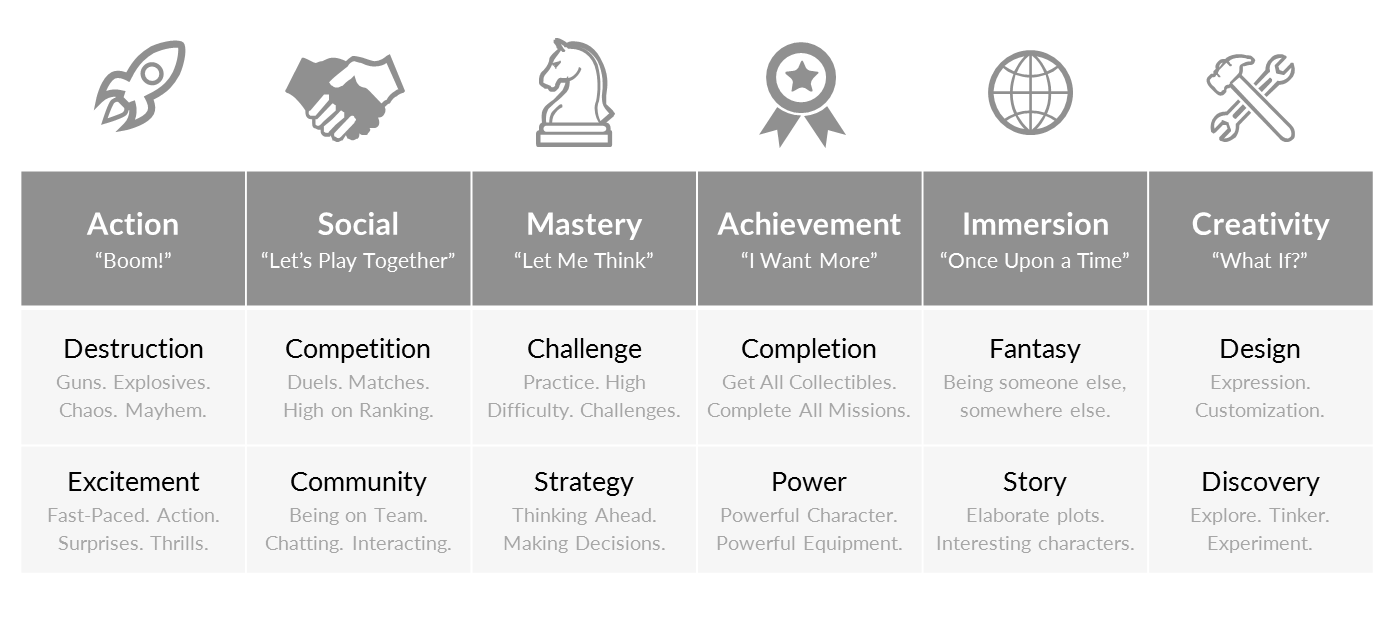
When we looked across these motivations and examined which ones were most common across ages and genders, some commonalities and differences popped up pretty quickly:
- "Completion" – meaning, collecting stuff and completing sets and task lists – is pretty much in everyone's top five.
- "Destruction" skews younger, and also male.
- "Fantasy," the motivation driven by immersion, is universally popular.
- "Story" doesn't pop as high as you would expect!
After some debate, we decided that for our game, we would treat these things as the core of our unique appeal:
- Community: The enjoyment of interacting and collaborating with other players.
- Fantasy: The desire to become someone else, somewhere else.
- Completion: The desire to complete every mission, get every collectible, and discover hidden things.
- Discovery: The desire to explore, tinker, and experiment with the game world.
- Design: The appeal of expression and deep customization.
And we decided that these items were not core. That doesn't mean we ignore them or have no features for these motivations, but it helps us define what we are not:
- Challenge: we are not Dark Souls. We want players to feel challenged, but we don't want to center the game on being the hardest experience ever.
- Story: we are not Uncharted. We want players to feel immersed, but we aren't going to have them sit back while we tell them a story.
- Power: we are not a game that someone wins and dominates everyone else, like say League of Legends. In fact, we are going to have a bunch of mechanics that cap people's power, in the name of serving community.
We then went through every feature we wanted to have in the game, and looked at which motivations they could serve. And we invented features and cut features until we had more things in the columns for the elements that are core, and fewer in the columns for the motivations that are not core.
TESTING ASSUMPTIONS
After all that, we made game for a few years. And relatively recently, we were able to go back and test again, to see if what we've made is getting close to that target, which has evolved as the market has. We put together descriptions of what the game has evolved into, and asked possible players to respond to what they heard.
We told them we were making a shared multiplayer world with many planets but a single universe. A world where you can play any role and learn any skills, with no class limitations. Where you can explore new planets, harvest resources, trade, craft, fight aliens, collaborate with others and transform for the worlds themselves.
We told them you could craft thousands of items both useful and decorative, and that someday you might get so good at it that visitors might come from far away to buy items with your brand on them.
That you would trade across the galaxy in a player-driven economy, where goods have varying prices in different locations. Buy low, sell high, smuggle or own a shop.
Sculpt the worlds, terraforming them and replanting, rerouting rivers and shaping them to the needs of you and your friends. Planets where every substance has unique properties, and creatures have needs and desires. A sophisticated ecological simulation where forests can catch fire and lakes can freeze over, and more.
Active combat with dodging and blocking and situational awareness, with an arcade style but also with options for people who have bad aim or no aim at all. And which players of different skill levels can still play together.
A social world where you can earn XP from helping each other or helping players. Where you can become a leader like the mayor of a town or governor of a planet, but can also play solo and only return to town when you need to buy and sell.
And we asked them to imagine exploring these worlds, traveling through wormholes to discover planets with unknown flora and fauna, unknown resources, and unknown mysteries.
What we got back was a lot of interest. In fact, exploring those living worlds scored through the roof! We also got back worries about griefing, about whether there would be a clear sense of which goals to pursue, and whether the game might be too grindy.
Most importantly, we found that there absolutely was a market for the game we are making. In fact, there's quite a big market.
We make decisions every day on how deep or detailed to make a feature, or whether we can afford to build it at all. There are plenty of cool ideas we have had which are pushed off to post-launch. We have to be realistic about what we can make.
But it feels great to know that you are making something that not just you feel excited about, but that there's a lot of other people who will be excited once they hear of it.
And that's why this weekend is so exciting too. Oh, those poor first Reachers will barely get to see anything! We expect to just crash the client over and over.
But with any luck, we will post a group selfie screenshot of the first strangers to join us on the limitless frontier of Stars Reach.
- THE ADVENTURER
-
WHAT STARS REACH IS, AND IS NOT

-
WHAT IS STARS REACH ABOUT?

von Raph Koster
It might be hard to believe now, but a couple of decades ago, plenty of designers didn't think that games could be art. They didn't think that there was any greater meaning, that it was enough if games were just fun and didn't have anything more to them.
These days, we have a lot more awareness that games can mean something, carry artistic statements, and can do while still being fun. In fact, one of the standard ways of thinking about game design now is to start with the idea that you want to evoke a particular experience for the player.
That calls for knowing what your game is about. This then cascades into knowing who your game is for, because no one game can be for everyone.
For years now, I have used a little vision exercise in order to help clarify thoughts around this issue. It consists of just four questions that you can ask of the game that help tie together the thematic side of the game with the game rules and mechanics.
Games where these two don't match often don't "feel right." You end up feeling like you are going through the motions in some storyline but really are just popping XP bags for loot.
WHAT IS THE GAME ABOUT (THEMATICALLY?)
After ruining our homeworlds, we are given a second chance to learn to live in harmony with one another and with the natural world as we venture forth into the galaxy.
In our Überlieferungen, humans of various sorts are all the result of genetic engineering experiments conducted by the Old Ones, a powerful and long-vanished galactic civilization. But we now have done what you'd expect of humans (we're only human after all): we've made a mess. Whether it's global warming, peak oil, nuclear winter, or global pandemics, we have managed to ruin the planets from which we come.
This game is about different sorts of people learning to get along, and to learn how to steward what we have. Crucially, this is a lesson that the Old Ones themselves, for all their power, don't seem to have learned themselves.
It's all fine and dandy to say that this is what we want the game to be about, but that means that what the player can actually do has to line up to these goals. There have to be game systems that offer second chances, game systems that teach us to live in harmony with each other, and game systems that represent the natural world and how we interact with it. So we ask the next question:
HOW DOES THE PLAYER DO THAT (THEMATICALLY?)
Diverse groups of people with very different ways to play come together to build new societies, and grapple with the problems of building sustainable space settlements.
More features the game needs start to crystallize now. In order to learn to live in harmony, we need difference. The game has to supply multiple ways to play which sit at comparable levels of importance. It's not that it needs to appeal to everyone, but that it needs to support a spread of player types that help each other mutually survive.
Similarly, if we want to provide players with a laboratory about stewarding the world, then there need to be game mechanics that relate to that goal. The game itself needs to put the idea of sustainable settlements front and center. If we built a typical MMORPG where stuff repops infinitely, then this question would never even come up!
As you can see, game systems start to take shape from these questions, because the theme demands them. And already, they are forcing us to do things differently than most MMOs do.
So now let's ask the same questions but in a different way. Until now, we have been framing these within the fictional context, within the fantasy. What do the above answers turn into if we think of them in raw min-maxing numbers?
WHAT IS THE GAME ABOUT (MECHANICALLY?)
Players work together to maximize their economic standing and in-game investment without destroying the resource pools they draw from as they build up their in-game investment and social groups.
Now we are really into system design! This description is the same as the thematic one, but it's framed up in terms of goals and currencies and rules. We need a game where players are working through progression systems like usual, but collectively, not just on their own. That suggests some sort of system of collaborative progress, where the diverse types of players all are pushing towards similar meta-game goals.
There's a classic collaborative game mechanic that is perfectly suited to that, which is often called "barn-raising" in game design circles. Think of it as a collective goal that every player can contribute to individually, even while they pursue their own interests. This idea will serve as the backbone to our player government system: players in Sterne Reichweite will work together to improve and progress their planets from wilderness to settlements and thence to cities and planetary governments.
The second half is far trickier. We want the players to engage in this activity but also have to be good stewards of the resource pools available. By this we mean the ores, the wood, the creatures they fight, and so on. This idea led us to the idea that planets must be capable of being destroyed – but also revived. That they should have health bars, so you can see how you are doing in managing them.
Players have to be able to see, at every moment, that what they do matters to the game environment. And from that powerful idea comes the entirety of the living world simulation that underlies Sterne Reichweite.
So that's goals… what about the moment to moment? Well, we can once again ask the same question we did previously, but through a game rule lens rather than within the fiction:
HOW DOES THE PLAYER DO THAT (MECHANICALLY?)
Players form economic dependencies on each other's characters by advancing in diverse specializations and skills, all of which draw from the common exhaustible resource pools available in each zone, thereby creating a Tragedy of the Commons problem to navigate as a group.
We rely on players being self-interested! If we have every player out for themselves, and many ways to play, we can have all the ways to play depend on the resources in the world.
Then we can make the players loosely dependent on one another. Oh, not on specific individuals necessarily – we want to preserve the ability to play the game solo, as part of our pillar on accessibility. But economically, by having one playstyle rely on the existence of another playstyle.
This concept becomes the map of our player-driven economy. Combatants need someone out there who makes blasters. Crafters need someone out there who mines the materials for blasters. Miners need someone out there who maps these alien worlds and finds the deposits of rare minerals. And explorers need those combatants to keep them safely out of the bellies of giant carnivorous mushrooms.
If we instead made looting monsters the supplier of all economic value, then all economic power would flow from combat. Our thematic message would be lost. We want players to be thinking about the fact that it takes all sorts of people to build a society.
We have one special advantage in approaching things this way: The Tragedy of the Commons is a lie. The basic premise of the idea was that given human actors and a common resource, some asshole is always going to hog it all for themselves and ruin it for everyone else. And in fact, we have seen plenty of people who hear about our game and assume that griefers will inevitably win out here too, digging up every scrap of the landscape and ruining the planets for everyone else.
But… in reality, humans have successfully managed commons for millennia. In fact, a Nobel Prize was awarded to Elinor Ostrom for her thorough refutation of the concept.
 The only time that the Tragedy of the Commons comes true is when you accept the premise in the first place!
All that is needed is for the players to have the tools to collectively manage their space. We as a team definitely need to nail that aspect. And then, yeah, it gets hard, because trying to solve for everyone's competing needs and desires means a lot of compromising and negotiation and tough choices.
Well, in a game, negotiation and tough choices are called gameplay. We as designers need to give Sie the tools to manage the space and prevent the one griefer from using up your commons. But after that, it's on you, the players, to figure out how to solve the larger problem of allocating the resources, deciding how much to build up your world at the price of losing your wilderness, and so on.
In the end, we hope that we see players land at many solutions for this, not one. We at Playable Worlds are not trying to be prescriptive about it. Instead, we want to see the thousand solutions this vast laboratory creates. And sure, some of those attempts will most assuredly end in strip-mined planets cooked down to the bare bedrock. That's okay. We have procedural, simulated worlds. If you wreck one, we can just generate another.
So yeah, Sterne Reichweite is kind of a climate change metaphor. It's a political metaphor. Remember, it's about different sorts of people learning to get along, and to learn how to steward what we have.
Games can have greater meaning. And that meaning can matter well outside the game. If any one of those solutions you try out for fun on our infinite planets works out, we hope that maybe you can turn around and apply it to the real world.
Because we only get one of those.
-
STERNE ERREICHEN SPIELSÄULEN - TEIL DREI

Hello everyone, I'm back with the third chapter in our exploration of the pillars for our vision of Stars Reach. Today I'll be talking about the ones that get much more concrete about how the game works.
It's been great to see the discussion of these pillars on the official Diskord und MMO-Seiten online!
The last big pillar starts out by describing the setting of the game. There's a lot of stuff piled into a single overstuffed sentence, I admit! But we wanted to capture all the key elements that make the galaxy of Stars Reach what it is.
Ein unendlich erforschbares, lustiges Retro-Sci-Fantasy-Universum
Die Welt ist düster genug; unser Spiel wird visuell ansprechend und farbenfroh sein und eine optimistische und freudige Grundstimmung haben. Es wird Melancholie, Geheimnisse und sogar Angst beinhalten, aber dies wird innerhalb der übergreifenden Atmosphäre grenzenloser Möglichkeiten und des Vergnügens der Spieler geschehen. Hinter jeder Ecke wird es neue Aussichten, neue Dinge zu entdecken und neue Geheimnisse zu lüften geben. Neue Planeten werden gefunden (und verloren), alte Geheimnisse werden aufgedeckt, und es werden ständig neue Inhalte erscheinen, die es den Spielern ermöglichen, ihre eigenen Wege in einer Galaxie mit unendlichem Potenzial zu finden.Da sind eine Menge Adjektive drin!
A lot of settings aren't worlds. They don't necessarily lend themselves to MMOs. A setting that is great for an MMO has to have variety, it has to have rich texture to it, and a degree of coherence and realism that a purely character-driven IP doesn't have. We owe Tolkien a big debt for setting the template for detailed worldbuilding in service of an epic story.But worldbuilding also has a "flavor" to it. The setting of Mad Max has thematic implications, and it'd be pretty darn weird to set the stories of, say, Studio Ghibli movies in a setting like that. (When they did their own post-apocalyptic thing, in Nausicaä, it was pretty different).
So let's focus first on the "retro sci-fantasy" bit. Why retro? Why call back to older rocket-and-rayguns stuff?
It isn't because we want to aim the game towards people old enough to remember that stuff from when they were growing up. And it's not because we want to aim towards kids (a lot of that iconography has aged downwards as it has been used by toys).
Rather, it's because we want to capture the spirit of that sort of sci-fi. It came from a period before, during, and post World War II where there was great enthusiasm about the power of science and the potential of humanity. Today, we see that retrofuturistic style used as a way to evoke the lost dreams we once had.Here are a few images from our "mood board" of artwork that reflect that sense of possibility… but also the danger that can be out there.


Images from left to right: "Atomic Avenue #1", art by Glen Orbik, Klaus Bürgle "Skyscrapers of the Future", Don Newton "Unknown Worlds of Science Fiction" special #1, 1970s
Nach dem Ende des Krieges entfernte sich die gedruckte Science-Fiction von der optimistischen Stimmung (die Medien-SF auf dem Bildschirm und in Comics brauchte eine Weile, um aufzuholen). Das Goldene Zeitalter wich der New Wave SF, die die Menschheit und die Zukunft viel pessimistischer betrachtete. Seitdem ist die Science Fiction der Technologie gegenüber sehr viel ambivalenter eingestellt. Selbst die wichtigste Weltraumoper unserer Zeit, Star Wars, ist düster und schmutzig.
Letztlich geht es dabei um die Kernthemen unseres Spiels und unserer Geschichte:Stars Reach ist ein Spiel über Hoffnung und Optimismus. Die reale Welt ist düster genug. Wir wollen das Gefühl der Möglichkeit einfangen, das in der Science-Fiction des Goldenen Zeitalters vorhanden war, das sensawunda ("sense of wonder") that it evoked.
That doesn't mean we have to shy away from serious themes or dark elements in the storylines. Wir brauchen eine Welt, in der viele verschiedene Arten von Geschichten möglich sind. Aber sie sollte in einer insgesamt optimistischen Stimmung präsentiert werden.
Humor ist Freiwildaber wir neigen zu Witz, Karikatur und leichtem Humor, wie
opposed to cartoon, slapstick, or "easy" dad jokes. This is not a comedy game.
It's a game that takes things lightly.Die Überlieferungen really deserves its own blog post, because a lot of thought went into it. It's designed to provoke questions, and in keeping with the other pillars, it's meant to be easy to approach but offer depths that aren't apparent on first glance.
Das Spiel wird eine tiefgründige Geschichte haben.
Wie Tyrion am Ende von Game of Thrones sagte, sind es Geschichten, die uns zusammenhalten. Die Stammesidentität wird durch die Kultur bestimmt, und die Kultur wird durch Geschichten bestimmt. Wir wollen einen neuen Stamm schaffen, die Spieler unseres Spiels. Wir können im Laufe der Zeit Entdeckungen machen und die Komplexität von langlebigen IPs fördern, ein Netz von Charakteren und Motivationen, die Fan-Fiction, Cosplay und Ähnliches hervorbringen. Diese Dinge sind es, die eine lang anhaltende Fangemeinde schaffen.Das zentrale Thema des Spiels ist, dass unsere Spielerspezies ihre Heimatwelten geplündert und zerstört haben, während sie sich an den Rand der interstellaren Zivilisation vorgekämpft haben. Nun haben diese Spezies eine zweite Chance erhalten: eine Galaxie mit terraformierten Welten, auf denen sie ihre Zukunft aufbauen können.
Werden sie die Lehren aus dem Schicksal ihrer verschiedenen Heimatwelten ziehen? Um dieses Thema zu unterstützen, muss der verantwortungsvolle Umgang mit diesen geerbten Planeten durch das Spiel belohnt und die gedankenlose Ausplünderung bestraft werden.
Among the things that we want to make sure the lore represents are an understanding of the grand sweep of history, themes of cross-cultural communication, how one deals with a Galaxy where a genocidal species basically swept thousands of planets clean, a feeling of uncovering a deep past… one of the central mysteries is, where did the Old Ones go and why did they leave? We don't know whether they annihilated themselves, decamped to greener pastures, or were exterminated by something even more terrifying.Alles in allem ist Stars Reach also fröhlich, optimistisch und farbenfroh, aber auch fähig, gewichtige Themen und starke Charaktere zu vermitteln. Sie soll Hoffnung vermittelnund es ist auch ein Spiel, das mit sich selbst und den verwendeten Tropen zwinkert und nickt. Wenn ich alles zusammenfassen müsste, dann wäre es we're going into space, and it's going to be awesome.
Now, if you've followed the reception to SR online, you probably already know that the graphics are a bit controversial. I'll restate again that we aren't at all done with the visual style. But I also won't lie, nailing an art style for the above is challenging. It ties back to whether the basic presentation is conveying that tone but also stretches to accommodate all the tonal variety we want in the lore and setting – and also reaches the audience we want.
One of the challenges with a hyperrealistic style is telling all the games apart. As rendering capability has increased, realism is starting to get… kind of boring. From a business standpoint, we need to stand out in the market. We also need to keep costs down, and our technology that allows us to stream content down on the fly works more cost-effectively with less load in terms of highly detailed textures. But lastly, high realism tends to tell broader audiences "this game is not for you." It signals to people that the game is complex, unapproachable, and often specifically chases away women players.
Das Spiel wird einladend, lustig und schön sein.
Ausgefallene Produkte mögen die Kernzielgruppe ansprechen, aber die meisten Dinge für den Massenmarkt sind eher sonnig und farbenfroh. Wenn wir die Kundenbindung erhöhen wollen, müssen wir dafür sorgen, dass das Spielerlebnis nicht stressig ist; es muss eher eine Flucht als eine Tortur sein. Wenn wir wollen, dass die Leute in dem Spiel leben, müssen wir dafür sorgen, dass es sich lebenswert anfühlt.
Ich erinnere mich lebhaft an zwei großartige Beispiele von früher - als World of Warcraft herauskam und als Dark Age of Camelot herauskam, fühlten sich beide sofort bunter und einladender an als Everquest es war.
This is a hard line to walk. When we were doing early concept art, we actually developed a "realism to cartoon" scale, where we made sketches of a human avatar's head, in styles ranging from kids' cartoon through to realistic, and told ourselves, "never fall below a 7 on this scale." But it's a long way from sketches to in-game art, and we still have more work to do.Dies führt zu einer Reihe von spezifischen Zielen für den künstlerischen Stil des Spiels:
-
- Machen Sie aus der Grimdark-Sci-Fi das, was World of Warcraft aus der Grimdark-Fantasy gemacht hat.
- Bright and colorful — a place you want to be.
- Hohe Schönheit, nicht hohe Wiedergabetreue - das heißt, es ist wichtiger, dass die Umgebung attraktiv ist, als dass sie superhochauflösende Texturen und realistisches Rendering aufweist.
- Das kann lustig und sogar witzig sein, aber das sind Archetypen, keine Cartoons.
- Familiar tropes that serve as "anchors" for players' imagination, because much of the best visual design leans on things that are already familiar, then add a twist – rather than going all out weird with something that people can't relate to
- Starke Silhouetten und ikonische Formen, die sich in verschiedenen Kunststilen bewegen können.
- Einflüsse aus Karikatur und Anime sorgen für einen modernen Look.
- Iterative Entwicklung: Wir testen unser Material und sehen, wie die Spieler darauf reagieren.
You can be sure that as we continue to iterate the art style, we'll be doing a lot of that last one with you all!
Bei unserer letzten Säule dreht sich alles um das Gameplay.
Das Spiel wird ständig neue Inhalte hervorbringen.
It is expensive to make content. We want to enable players to create as much as possible, and we want to enable the game to create as much as it can as well. It has to be constant, because we want players to always want to learn about what's going on. We want them to feel like it's something that stays fresh and evolves and makes them want to check in regularly.Now, this doesn't exclude content we create. But that's sort of the default assumption these days in design: that the designers will populate all the content. Designing for the game itself to drive emergence doesn't mean that we abdicate our responsibility to create engaging content. But it does mean taking a look at every single system to ensure that it isn't reliant on that.
Daraus ergaben sich eine ganze Reihe ziemlich spezifischer Prinzipien, die das Spieldesign sehr stark geprägt haben.
Wir haben beschlossen, dass Sammeln, Handwerken, Siedeln und Kämpfen were the core activities of our game. This wasn't arbitrary, either. It was driven by the audience we are after, which is a large one, and a diverse one in the sense that it is made up of players with varied gameplay preferences but who all like existing in a sandbox together where they interact.
Das bedeutete dann auch zwei große Dinge:-
- Die gesamte Spielwirtschaft wird von den Spielern bestimmt.
- Der Kampf ist eine Option und nicht der Kern der Spielschleife.
To many players, these two things may feel like a marginalization of combat. The fact is that combat usually marginalizes everything else, so every once in a while turnabout is fair play! I was wondering online a while back on Reddit, "when exactly did we start calling everything else you do in an MMO 'life skills?'" The default current of MMO design usually puts combat at the center, and relegates other ways to play to "side games."
Jeder hat immer das Gefühl, dass seine bevorzugte Art zu spielen dominieren sollte, und kann sogar ziemlich nachtragend werden, wenn andere Spielweisen präsent sind. Aber es gibt gute Gründe, alle mehr miteinander zu verflechten.
Wir wollen die Gemeinschaft zuerst weil es bei MMOs um andere Menschen geht. I often describe virtual worlds as "be someone you aren't, somewhere that you can't be, with others." That's the heart of the unique offering of MMOs. You can get individual bits of that sentence elsewhere, but there's something magical that happens when you get all three from one experience. And it leads to a few more goals:
-
- Eine spielergesteuerte Wirtschaft, die soziale Bindungen fördert - denn jede unterschiedliche Spielweise kann über die Waren und Dienstleistungen, die dieser Spielstil hervorbringt, mit den anderen in Verbindung gebracht werden.
- Similarly, having multiple guild types and multiple guild membership also helps foster strong ties. Basically, a common pattern that we see (and a common mistake, we've come to realize) is trying to make human relationships one-size-fits-all.
- "Increase communication bandwidth." Chat, emote animations, etc, should be very important, because the higher the bandwidth for emotion and humanity to pass through the game, the more likely players are to behave, because it's easier to recognize the people on the other side of the wire as being people like yourself.
Das bedeutet natürlich, dass Sie erkennen müssen, dass es braucht alle möglichen Leute, die auf ihre eigene Art und Weise spielen, um eine Welt aufzubauen. Diese Art von vielfältiger Spielerbasis ist etwas ganz anderes als die Jagd nach einem super engen Publikum von Spezialisten für nur eine Spielweise. Die Wette, die wir eingehen, besteht darin, dass die Bandbreite an Spielstilen in einem Spiel Leute anspricht, die genug von einer bestimmten Spielweise haben. Wenn man von einer Spielweise gelangweilt ist, kann man eine andere ausprobieren.
Wir denken an diese Bandbreite des Spiels auf verschiedene Weise. Wir müssen verschiedene Arten von Spielern unterstützen - verschiedene Altersgruppen, Geschlechter (viele Spiele vergraulen Demografien durch die Wahl des Grafikstils, wie oben erwähnt), Ethnien und so weiter. Wir müssen auch verschiedene Spielstile unterstützen; wir haben beides verwendet Quantische Gießerei und Solsten models to think about our players at different stages of the game's development.
Und schließlich müssen wir gleiche Ausgangsbedingungen schaffen some between new players and old pros. The power accumulation curve of most MMOs results in friends being unable to play together as soon as one of the members has more or less time to play than the others. MMOs have long recognized this problem and built design hacks into the system that basically "undo" you advancement when playing in mixed-level situations. The first one of these was "sidekicking" in City of Heroes in 2004, but nowadays we have level scaling and other approaches, all of which are fundamentally about ignoring the level system that the game is designed around.
Since we favor horizontal progression, where instead of "numbers go up" we have "number of commands goes up," we can avoid this issue. In our game, your hit points won't go up noticeably. And you will do more damage not because you leveled up or your gear got better, but because you compounded tactics together that you unlocked with skills.
Damit ist die Serie über die Grundpfeiler des Spiels (endlich) abgeschlossen. Ich hoffe, es war ein interessanter Blick hinter die Kulissen, wie wir versuchen, ein riesiges Projekt wie Stars Reach in etwas zu verwandeln, das ein Team bewältigen kann.
That's it for this week, but I'll see you around the Diskord, or Reddit, or wherever your favorite theorycrafting community is, and if you want to talk about these pillars, I'm always up for it!
-
-
STERNE ERREICHEN SPIELPFEILER, TEIL ZWEI

von Raph Koster
Hallo zusammen,
I'm back to talk more about our design pillars for Sterne Reichweite. Letztes Mal habe ich ein MMO als einen virtuellen Ort beschrieben, in den wir Spiele einbauen, und nicht als ein Spiel. Ich habe auch versprochen, dass ich heute über die Prinzipien sprechen würde, die die Spiele - den Spaß! - den wir zu bieten hoffen.
Just like the last set, these are organized into a big statement, with three consequences of the statement. What I didn't talk about last time was that even the three consequences break apart into a bunch of even smaller ones, which become more like design rules that we try to follow as we do our work.
Das große Ereignis dieser Woche verdient eine kleine Vorrede.
Look, we all know that the audience feels like MMOs haven't really progressed much. A lot of the action in online games has shifted over to looter-shooters, survival crafting, and the like. These genres are children of MMOs, streamlined down to make them more accessible in a bunch of ways.
MMOs waren schon immer große, schwerfällige Biester. Viele Spielschleifen, viele Inhalte in einer großen, ausufernden Welt, die sich sehr unfreundlich anfühlen konnte und in der man sich nur schwer zurechtfand. Deshalb war es eine Offenbarung, als World of Warcraft aufkam und einen Schritt für Schritt durch den Leveling-Prozess führte. Es beendete die Tage der totalen Verwirrung, zum Preis der totalen Freiheit.
Dieser Weg wurde weiter verfeinert, aber its end destination isn't a traditional world anymore. It's more like a looter-shooter. Das Schicksal 2ist schließlich so etwas wie ein MMO, bei dem der Weltteil herausgenommen wurde.
Ironically, feeling more like a world has been flourishing in single-player games. Whether it's Eldenring oder die jüngsten Zelda-Titel, gibt es diesen Trend zu offenen Welten, die sich lebendiger anfühlen. Und Breath of the Wildhat uns allen gezeigt, dass man eine sehr zugängliche Sandkastenwelt schaffen kann, wenn man das Interface und das Gameplay richtig gestaltet.
This matters because I've always felt that Sandkastenspiele sind beliebter als Orkjagden, despite the conventional wisdom that sandbox games are more niche. Oh, it's not to say that orc-slaying isn't awesome and fun. Of course it is. But I think we all know that decorating a house, or running a business, or engaging in carpentry or cooking or other crafting, is just a more widespread human activity. Sandboxy gameplay by nature offers more than kill, kill, kill, and should broaden the audience. If only it weren't so intimidating and confusing.
Damit sind wir bei der wichtigsten Säule angelangt:
Die Leichtigkeit von Nintendo trifft auf die Tiefe eines Sandbox-MMOs
Das Spiel wird eine tiefgreifende Simulation bieten und den Spielern die Freiheit lassen, selbst zu entscheiden, wie sie spielen wollen. Aber das Spiel wird die Komplexität der Benutzeroberfläche auf das beschränken, was mit einem Game-Controller oder einem Touchscreen erreicht werden kann. Es wird Eleganz gegenüber visuellem Ballast und Komplexität bevorzugen, und es wird mehrschichtige Benutzeroberflächen verwenden, so dass die Spieler nie zu viele Entscheidungen auf einmal treffen müssen. In Anbetracht des Wunsches nach Einfachheit und Zugänglichkeit werden wir uns schließlich bemühen, Clients für viele Geräte anzubieten.
A lot of gamers probably worry that having things be easy on the surface means that the depth won't be there. But these ideas aren't mutually incompatible. One of the oldest statements about games is that they should be "easy to learn, hard to master," after all. Among some gamers, there's even a point of pride in dealing with frankly overcomplex and intimidating controls, a sort of sunk cost fallacy of "well, I learned it so it must be good."
Aber Wenn wir MMOs aus ihrem Trott herausholen wollen, können wir nicht zurückblicken. zu den Interface-Konventionen der Vergangenheit, zur Komplexität, die zu Bildschirmen führt, die mehr Knöpfe haben als andere Menschen. Wir müssen MMOs so gestalten, dass auch Nicht-MMO-Spieler bereit sind, es zu versuchen. All die Vorzüge, die erfahrene MMO-Spieler erwarten, können immer noch vorhanden sein.
Wenn wir also über diese große Kernaussage nachdenken, landen wir bei drei Punkten, die sie impliziert. Denken Sie daran, dass wir nicht nur darüber nachdenken müssen, was dem Spieler Spaß macht, sondern auch darüber, was ein nachhaltiges Geschäft ausmacht. Glücklicherweise ist nachhaltiger Spaß gleichbedeutend mit einem nachhaltigen Unternehmen!
"The game will be deep: a set of proven game mechanics brought together in one universe."
The core premise is that we can marry ease of use to depth. Why? Because ease of use maximizes audience, and depth maximizes retention. We will make our money by holding people over the long run. We don't need to be the most popular game in the world, we need to "maximize the area under the curve," which means that retention wins over the long haul. If we can become a hobby for people, we can continue to drive revenue over years (and not just from the game, but from ancillary extensions of the IP as well).
So much of what has gone wrong with game services has been the trend towards trying to maximize revenue. We aren't after that goal; Wir wollen stattdessen die Begeisterung der Spieler für das Spiel maximieren.. Ein tolles Spiel kann zu einem Hobby werden, das viele Jahre andauert! Deshalb ist Ultima Online feiert bald sein 27-jähriges Bestehen und wird von mehreren Generationen gespielt.
And if we can keep driving revenue, we can keep updating the game, keeping it current, and giving people joy. And that's what it's all about, isn't it?
Was verstehen wir also unter bewährter Mechanik? Nun, ich habe erwähnt, dass sich aus diesen Aufzählungspunkten Gestaltungsregeln ergeben. Einige von ihnen, die wir auf dieser Säule aufbauen, sind
- Einfache Systeme können ein tiefgründiges Spiel unterstützen; denken Sie an Go oder Schach.
- MMOs erfordern Tiefe, abwechslungsreiches Gameplay, ein Universum, das es zu erforschen und zu meistern gilt.
- Our dev team "plays jazz": We experiment, iterate, and find the fun.
- If something doesn't sing, if a system isn't fun — fix or or kill it.
We look back at other games, particularly MMOs, constantly, looking for the best version of a given system. We aren't reinventing every wheel here; we picked our big battles like our living world simulation, and made those our core innovations. But there are so many great games out there that you can't experience with others in an MMO. Wenn wir diese Erfahrungen in ein gemeinsames Umfeld einbringen können, verändert das ihre Gefühle ganz erheblich.
Mit anderen Worten, warum sollte man nicht die besten Gebäude aus Spielen wie Die Sims und auch aktuellere Dinge wie Umhüllt? Warum nicht auf die erfolgreichsten Kampfspiele zurückblicken und Ideen klauen? Das Design von Spielen basiert schließlich auf anderen Spielen.
Das Schwierigste an diesem Entwurf ist, ihn zu halten dicht. Viele Leute haben gesagt, dass unsere Vision sehr kühn und ehrgeizig zu sein scheint. Die einzige Möglichkeit, ihn zu bauen, besteht darin, dass die einzelnen Teile klein und elegant sind. Es muss ein Regelwerk sein, das mehr an Go erinnert. Ich sage den Leuten im Designteam oft, dass sie mich zu jedem Spielsystem überreden müssen, das mehr als drei oder vier Regeln und drei oder vier Variablen verwendet. Man kann eine Menge Daten in a system like that, without making the coding and balance a nightmare. (A deck of cards only has three variables: 13 numbers, 4 suits, and 2 colors. That's it, and yet look at the depth of all the card games made with that small set!)
Probably the best example of that in what you have seen so far is the living world simulation itself, which is built out of surprisingly few rules (that's a big part of how we can scale it to this size!). Stuff in the world knows how to flow and fall, stick, change state, and react to other stuff. That's pretty much it. But from that we get a very large number of interactions and a ton of depth.
Die Bedienelemente und Schnittstellen werden intuitiv, einfach und vertraut sein.
Familiar is important because it means that users don't have a huge barrier to entry when they first show up. Intuitive and simple is important because it means both users who are coming to us for the first time, and users who are returning after an absence, don't have a huge learning curve and barrier to entry. It maximizes the possible audience. It also lets us go to multiple clients more easily.
Ich versuche oft zu unterscheiden zwischen Komplexität und Komplikation. Es gibt eine Menge Komplexität die in dem oben erwähnten Kartenspiel vorhanden sind. Aber die Grundform eines Kartenspiels ist nicht kompliziert. Beim Schach gibt es nur sechs Arten von Figuren. Go hat eine!
I worry, sometimes, that audiences won't understand that something that looks simple might be deep. I've seen comments from folks in our (wonderful!) Discord-Gemeinschaft that "hey, I don't see hotbars with a ton of buttons on the screen, so it doesn't signal MMO to me." But was ein MMO ausmacht, ist nicht die Größe der Hotbar. Was ein MMO ausmacht, sind die Aktivitäten, die man an einem virtuellen Ort durchführen kann.
Now, you still want familiarity, of course. That's what eases the player in. Some of the bullet points we have as design rules here include:
- Minimieren Sie die Lernkurve; machen Sie es den Spielern leicht, einzusteigen und zu spielen.
- You have two hands, so you have a few tools at a time. That's your current "class."
- Less bars: use techniques like BOTW's fatigue meter.
- Erledigen Sie so viel wie möglich in der Welt; Dialoge nur wenn nötig.
- Die Benutzeroberfläche muss butterweich sein.
Der zweite Punkt bezieht sich auf die Art und Weise, wie wir mit dem Spielerfortschritt und den Fertigkeiten umgehen ... wir lassen euch alle möglichen Dinge im Spiel lernen. Aber wir lassen euch diese Fertigkeiten mit Hilfe von Werkzeugen nutzen, und ihr könnt nur eine bestimmte Anzahl davon gleichzeitig mit euch führen. Man baut sich also eine Hotbar aus der Art und Weise auf, wie man in einer bestimmten Sitzung spielen möchte. Wenn man das ändern will, muss man im Grunde nur nach Hause gehen und die Werkzeuge ändern, die man in seiner Ausrüstung hat.
Letzteres ist eher ein langfristiges Ziel und etwas, bei dem ich mir Sorgen mache, dass Core-Gamer darüber die Nase rümpfen werden, ganz ehrlich!
Wir werden verschiedene Clients unterstützen, so dass die Spieler auf jedem Gerät ihrer Wahl spielen können.
…and that matters because we see particularly younger folks moving readily across computing devices. Mobile devices dominate gaming time, and are the gateway computing device. We want to be there where users reach for us, and the thing most users most often reach for is their phone. This lets us have more frequent touch points, which keeps users in the orbit of the game. Regular engagement is the biggest predictor of both retention and revenue.
Ich weiß, dass viele Gamer auf alles, was mit Mobiltelefonen zu tun hat, herabsehen und denken, dass es zu simpel ist oder darauf ausgelegt ist, möglichst viel Geld zu verdienen. Aber wir sehen das anders: Wenn etwas ein geliebtes Hobby ist, wollen wir es jederzeit in Reichweite haben. Und ein Telefon ist etwas, das man wahrscheinlich immer bei sich hat.
Ich betrachte die Geräte nur als Fenster zu der Welt, die wir in der Cloud für Sie alle aufbauen. They're just windows of varying sizes and control schemes. And someday, I want you to be able to use whatever window you have handy. Oh, you may not be able to do everything that way. Some sorts of gameplay will always work better with one control scheme versus another, with a larger screen than a small one.
So we're starting PC first, for sure. But already a pretty substantial chunk of PC gaming is happening on Steam Decks and similar devices, and the use of controllers for controlling PC games has gotten to be almost mandatory. So designing for a world like that makes sense if you want to be more futureproof.
All of these pillars end up being about the same things, really. Make it easy for players to participate, but have real depth and complexity inside what seems like a simpler wrapper. All too often surface complication tricks us into thinking there's real depth in there, when really there's a lot of stats that boil down to mostly the same thing. Wir wollen ein Spiel entwickeln, das die wahre Tiefe und Komplexität besitzt, die sich aus der Kombination einfacher Dinge auf unerwartete Weise ergibt.
As to how we get that complexity, well… that will have to be next week's post. In the meantime, I'd definitely enjoy it if you stopped by the Diskordwo wir Gespräche mit dem SR Gemeinschaft rund um diese Themen!
-
STERNE ERREICHEN SPIELPFEILER - TEIL EINS
von Raph Koster
Hallo zusammen,
I'm kicking off a little series of posts here on what our core game pillars are. Dies sind die bestimmenden Philosophien, die alles im Spieldesign beleben. Sie sagen uns, was das Spiel ist und was das Spiel nicht ist.
Wenn wir an der Gestaltung arbeiten, schauen wir immer wieder auf diese Grundprinzipien zurück und überprüfen unsere Arbeit an ihnen. Wir wollen sicherstellen, dass wir den Ideen, die im Zentrum des Spiels stehen, treu bleiben, weil alle Spielsysteme von diesen ausgehen.
We didn't just come up with these out of the blue. These were based on doing market research, looking at what things players have been asking for, what things have been missing from MMOs for a long time, and so on.
Es basierte auch auf Träumen darüber, was heute mit der aktuellen Technologie möglich ist. Wir haben das Gefühl, dass MMOs irgendwie stagniert haben. Damals, als ich an Ultima Online träumten wir von vollständig simulierten Welten, von Welten, die auf die Aktionen der Spieler reagieren können. Stattdessen haben wir uns in einem Modus eingerichtet, in dem wir als Entwickler dazu neigen, Freizeitpark-Fahrten für die Spieler zu machen, kleine konservierte Erfahrungen, durch die sie laufen, anstatt alternative Welten.
So our first pillar to talk about is therefore this one. Before you read it I should say, it's obviously aspirational, all these pillars are!
Die lebendigste Online-Welt, die es je gab
Die Art und Weise, wie wir uns diese Säule beschrieben haben, war die folgende, die wir direkt aus dem internen Entwicklungs-Wiki ausgeschnitten und eingefügt haben. Tatsächlich ist dies eines der ältesten Stücke der Entwurfsdokumentation des gesamten Projekts und geht der Erstellung von Code voraus!
Wirtschafts- und Umweltsimulationen bilden die Grundlage des Spiels, und die Spieler können aus einer breiten Palette von Möglichkeiten zur Interaktion mit den Systemen wählen. Die Spieler werden in der Lage sein, im Spiel Dinge zu tun, die sie schon immer erwartet haben: Gegenstände fallen lassen, Bäume in Brand setzen und Löcher in den Boden graben. Sie werden feststellen, dass die Welt Dinge tut, die sie erwarten: Der Wind kann einen tatsächlich umherwehen, man kann von einem steilen Abhang abrutschen, und der Schnee wird sich tatsächlich auftürmen und Dinge begraben. Und schließlich und vor allem werden die Spielercharaktere in eine lebendige Gesellschaft eingebunden, mit der Absicht, starke Gemeinschaften zu bilden.
Wie Sie sehen können, we intentionally defined "alive" as including what Spieler tun, nicht nur das, was die Welt tut. Wenn das, was die Spieler tun, die Welt beeinflusst, und wenn das, was sie tun, für die einanderdann verstärkt sich das Gefühl, dass es sich um einen alternativen Ort handelt.
In fact, you've heard us talk about our living world simulation tech a lot, but the fact is that the economic simulation that players are participants in is ebenso wichtig, even though it's not nearly as visually cool.
Ausgehend von dieser übergeordneten Säule haben wir drei spezifische Ziele, die wir anstreben.
"The game will run off simulation."
Die besten Spielzeuge werden durch Simulation gesteuert. Lego. Hot Wheels. Minecraft. Die Sims. Having building blocks that interact with each other in magical ways is what encourages a playful attitude to the game, which then leads to players surprising us with emergence. (But we won't be zu überraschen, denn wir werden von Anfang an auf diese Entwicklung hinarbeiten). Daraus ergeben sich dann neue Spielmöglichkeiten, neue Wege für die Spielwelt, zu wachsen und zu gedeihen, und so weiter.
The tension between simulation and what I call "stagecraft" has a very long history in online game design in particular. If you use stagecraft, you are basically "faking" reality, in ways that help guide players. This is often really necessary – it's very easy for players to feel like they are confused or lack guidance.
On the other hand, simulation, and consistent underlying rules, is where you get emergent gameplay from. This is both a blessing and a curse – it's hard to predict the outcomes, and they could be good or bad for fun! So when you design in a simulationist way, you have to always temper your approach and think of how to end up with Spaß Ergebnisse, im Gegensatz zu realistischen Ergebnissen. Realismus macht oft nicht viel Spaß.
Our core simulation is, of course, the environment. One of the questions that always comes up when we talk about our game with other developers is "what gameplay impact does that feature have?" And it's the rechts Frage.
We don't want to just have different types of dirt for no reason. They have to matter to a game system – such as farming. If we have different sorts of rock, the differences should matter – to crafting, say. If you can melt that rock, that can't just be a cool gimmick with no purpose. It has to matter in terms of giving players fun things to do. Maybe you can melt stuff to the point where its transmogrifies into something else! Maybe you can melt holes in front of creatures so they fall in and die during combat!
The point being, having a simulation that exists but doesn't provide gameplay is kind of pointless. We're not building a science experiment, we are building a game.
"The game will be a true persistent state world."
You can't have real history without persistence. You can't have pride of place. You can't tie players into the world unless there is a world to tie them into. This is what allows the crazy experiment players made to stick around and be experienced by others. This is what drives returns out of nostalgia. This is what leaves traces of lore to be found.
By itself, this is a technical requirement. Not a small one, either! But it's really about human behavior.
Worlds that are more theme parks don't have history within the game. Oh, sometimes developers have done things like destroy a zone as part of an event, or have expansions alter the map that already exists. But small things don't change day to day, and it means that players kind of just move through the environment.
Wenn wir die reale Welt erforschen, ist ein großer Teil dessen, was wir gerne finden, in Wirklichkeit die Spuren derer, die vor uns kamen. Wenn wir in der realen Welt von unseren Hinterlassenschaften sprechen, meinen wir damit die Dinge, die wir anderen hinterlassen, damit sie sie eines Tages erleben können, wenn wir nicht mehr sind. These are profoundly human feelings that games aren't tapping into.
Und ja, sie machen auch noch Spaß.
The history of online worlds is partly the story of slowly adding more and more persistence to the experience. In the earliest text based worlds, you only saved the state of your character. The world fully reset around you every once in a while. Eventually, this evolved into resetting each zone independently. I remember when the innovation of having repops per mob came along and it felt like the world had taken a big step forward is realism! ("Mob" is the term of art for "mobile object," so think "monster or NPC").
Similarly, we went from saving just what you carried (and often not all of it) to saving your corpse if you died, and then the contents of bank accounts, and so on. The definition of "your character state" got bigger over time.
These days, the largest way in which players tend to be able to modify the world is using a player housing system. But so many games tuck that away into an alternate dimension, basically, so that players don't leave a trace. It's really just a big inventory bag that looks like a house.
That's really not all that human structures are, despite our habit of hoarding stuff. The monuments we leave behind are often public works, plazas and pyramids, theaters and halls of government.
And yeah, it's okay if the works of players past, like those of Ozymandias, turn to ruins someday.
But it's really the last one of these three where it all comes together.
As an MMO, we are a live service game, and that means that we live and die based on people coming back, making the game their hobby for extended periods of time. That's just a survival thing, for any MMO. We have to design within business realities, not just for fun factor.
Luckily, the two can often coincide. But it means a big ol' block of text! Remember, what you are about to read may sound like it's cynical business talk, but it's not.
"The game will be driven by player community and interdependence."
Retention is driven by community above all. Social ties in the game are the biggest predictor of retention. Particularly now that streamers and the like are the biggest social hubs, replacing guild leaders, it's incredibly important that we tie users to us, not to the streamer or celebrity.
Wenn Welt von Warcraft eingeführt wurde, stahlen sie alle hochrangigen Gildenleiter von EverQuest. Similarly, we don't want someone to be able to steal our audience by persuading streamers away from our game. We have designed this game so that people don't identify with only one social hub. That's why we have systems such as multiple guild membership that drive loyalty to multiple hubs.
People can be very important to your life even if they aren't close friends. Think of that plumber or electrician you rely on, even though you don't really know them. Those relationships are called "weak tie" connections, and despite the name, they actually make the social network stronger, reducing the dependency on central hub people. When people depend on you, you are less likely to leave.
Und schließlich investieren wir intensiv in Spielerstädte, planetarische Regierungen, Wohnungen und andere dauerhafte Einrichtungen. Das sind alles Dinge, die man nicht mitnehmen kann, wenn man sie verlässt - und das macht es weniger wahrscheinlich, dass man sie verlassen will. Indem wir den Platz pro Planet begrenzen, verhindern wir, dass ein sozialer Knotenpunkt zu groß und damit zu mächtig wird.
Diese Bindungen sind wichtig, weil es sich um echte menschliche Beziehungen handelt. It's that healer you really trust in a fight to have your back. It's that crafter who makes the best armor, the one you trust the most. It's the person who shares similar play hours to you, and you come to know each other as friends. These are real ties, not fake ones. Real relationships.
Der Aufbau dieser Art von Freundschaften erfordert Arbeit, und in der realen Welt geschieht dies allmählich, wenn die Menschen einander vertrauen. Wie funktioniert der Aufbau von Vertrauen? Nun, es beginnt in der Regel mit Formen des Austauschs - einer erbrachten Leistung, einer Zahlung. Von da an werden Gefallen getan und Geschenke gemacht, und schließlich werden Vertraulichkeiten ausgetauscht und Gefühle geteilt.
This is why the player economy, and people needing each other for varying goods and services, is so important. It's an on-ramp to friendship.
Auch wenn unser Bedürfnis, die Spieler für eine lange Zeit an das Spiel zu binden, eine geschäftliche Notwendigkeit ist, erfüllt es auch ein sehr reales Bedürfnis der Spieler: die menschliche Bindung. Und genau das war schon immer der Kern des MMO-Genres. Es ist das, was MMOs von anderen Spieltypen unterscheidet. Bei MMOs geht es um die anderen Menschen in der Welt. Sie sind virtuelle Orte, an denen wir zufällig Spiele aufhängen.
But this is plenty long, so I'll talk more about those games next time!
-
STARS REACH ZUM STEAM STORE HINZUGEFÜGT
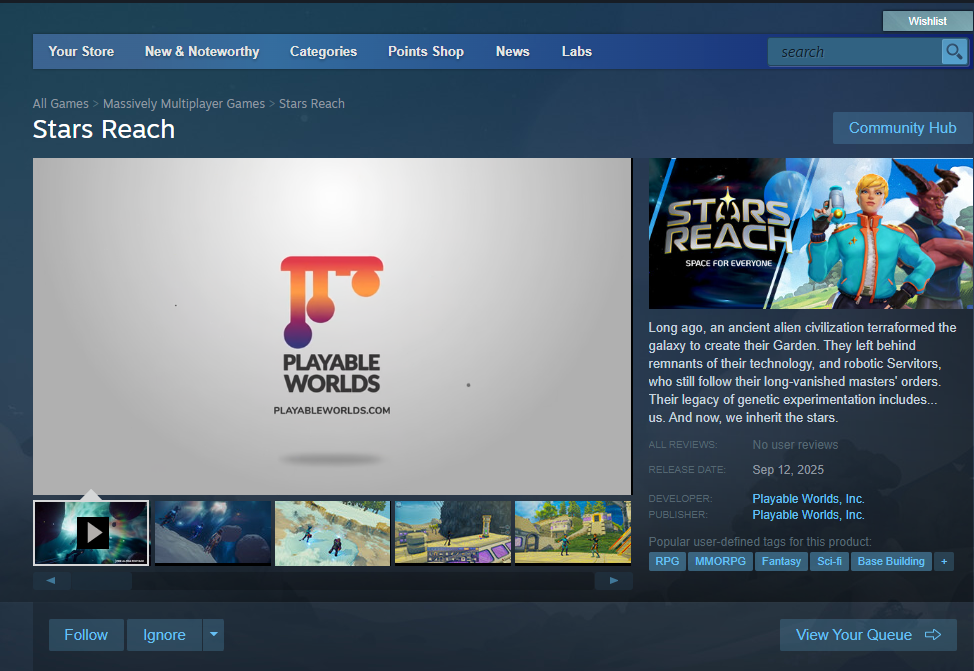
Steam hat eine Coming Soon-Seite für Sterne Reichweite in den Steam Store.
Neben einer Beschreibung des Spiels, 3 Videos und einer Reihe von Screenshots enthält die Seite auch eine Schaltfläche für die Wunschliste.
Bitte Wunschliste Sterne Reichweite auf Steam, damit der Suchalgorithmus das Spiel mehr Leuten empfiehlt. Wir schätzen Ihre Hilfe.
-
PLAYABLE WORLDS ENTHÜLLT ERSTES SPIEL: STARS REACH

Playable Worlds hat seinen ersten Titel angekündigt, Sterne Reichweite, a massively multiplayer sandbox, exploration, and alternate-life game. Playable Worlds also released three videos that focus on early pre-Alpha game play, Raph's creative vision, and Raph and the development team took questions from the community on what players can expect.
Stars Reach ist ein intelligentes, lebendiges, vollständig modifizierbares Universum, das den Spielern die einzigartige Möglichkeit bietet, das Leben auf fernen Welten zu erleben. Stars Reach heißt Spieler aller Erfahrungsstufen, Spielhintergründe und zeitlichen Verpflichtungen willkommen, um neue Welten zu erkunden, neue Freunde zu finden und gemeinsam neue Möglichkeiten zu entdecken.
Derzeit befindet es sich in der Pre-Alpha-Phase, ein Starttermin wurde noch nicht bekannt gegeben.
-
REDDIT KÜNDIGT RAPH KOSTER AMA FÜR DEN 28. JUNI 2024 AN

Das 258.000 Mitglieder zählende Subreddit /r/MMORPG wird am Freitag, den 28. Juni 2024, um 10 Uhr PST/1 Uhr EST/7 Uhr MESZ Gastgeber für Raph sein. Das AMA oder Ask Me Anything ist eine anerkannte reddit-Tradition. Seien Sie darauf vorbereitet, live Fragen und Antworten zu lesen oder sogar Ihre eigenen Fragen zu neuen und alten Spielen, Büchern usw. zu stellen.
Besuchen Sie den Subreddit für weitere Informationen hier https://www.reddit.com/r/MMORPG/.
Sterne Reichweitestarsreachteam2024-05-30T13:05:17-07:00