-
FIRST STARS REACH PLAYTEST: FOCUS ON STABILITY AND MOVEMENT

by Dave Georgeson
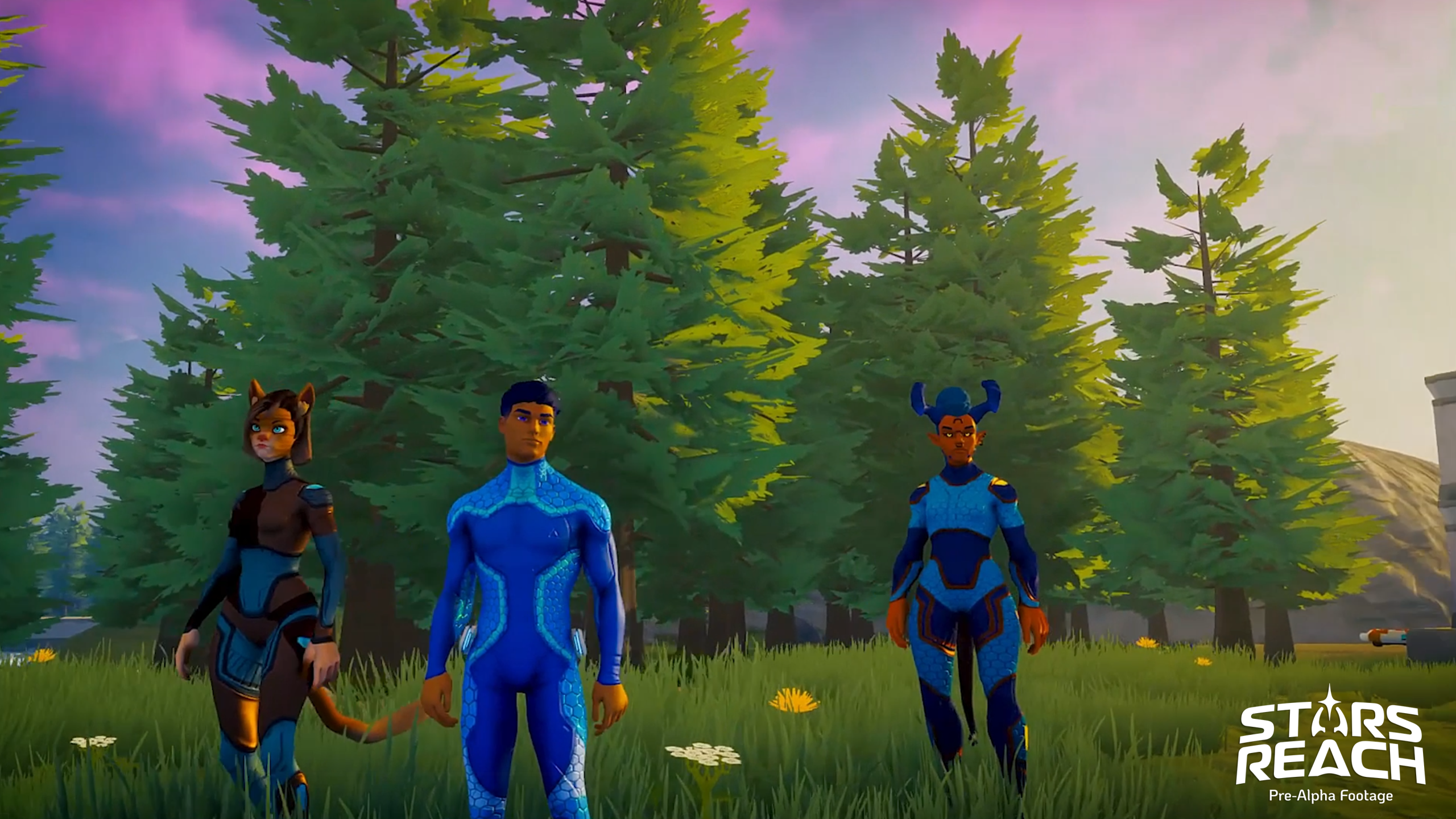
We had our first external test last Saturday, inviting a slew of people from the Stars Reach Discord channel to join us. Around 58 of them joined during the two-hour test, along with part of the dev team.
A good time was had by all. Although this first test was mostly about stability (making sure people could get in, that the servers were solid during the test and making sure our feedback channels worked), we also asked the playtesters to give us feedback on our movement and emote systems within the game.
Players were able to walk, run, sprint, stealth, dodge, jump, climb, grapple and grav mesh (anti-gravity flying) around the map, testing these various methods and letting us know how they liked them.
The verdict was strongly positive. Here's a few quotes from players posted after the test:
hooby: Between the options to run, roll, climb, grapple and fly and all of them being pretty fast and fluid, the movement in the game instills an incredible feeling of freedom. In summary: "weeeeeeeeeeeeee!"
Asclepius: I absolutely LOVED grapple and gravmesh – what a way to get around. And I'm pleased to say that on my machine the game ran as smooth as silk; frame rates mostly around 50-60, occasionally dipping to 45.
dao: The combination of grapple and grav traversal really does feel amazing!
Additionally, we asked players to test our 30+ emotes and 50+ conversation moods. The moods affect your word balloons to show off emotions and the emotes trigger animations and echo into the chat pane. Since most of this group of testers were veteran MMOers, they took to the system like ducks in water and immediately had fun.
Players were also highly receptive that they have a real chance to help mold the game by testing it so early and giving us their thoughts.
robo: I like that we're testing the game systems progressively over time as ya'll tweak them.
AlmostYouman: Overall, (I'm impressed by) the expansiveness of possibilities.


Players explored, hung out with devs, and even got some guided tours along the way after the first flush of excitement ebbed a bit.
Some other fun things that players encountered and discovered:
Rommi Noodles: I climbed over a wall and it turned out to be a dam!

AlmostYouman: There was a structure in the cave with a radiation leak. I died in the radiation.

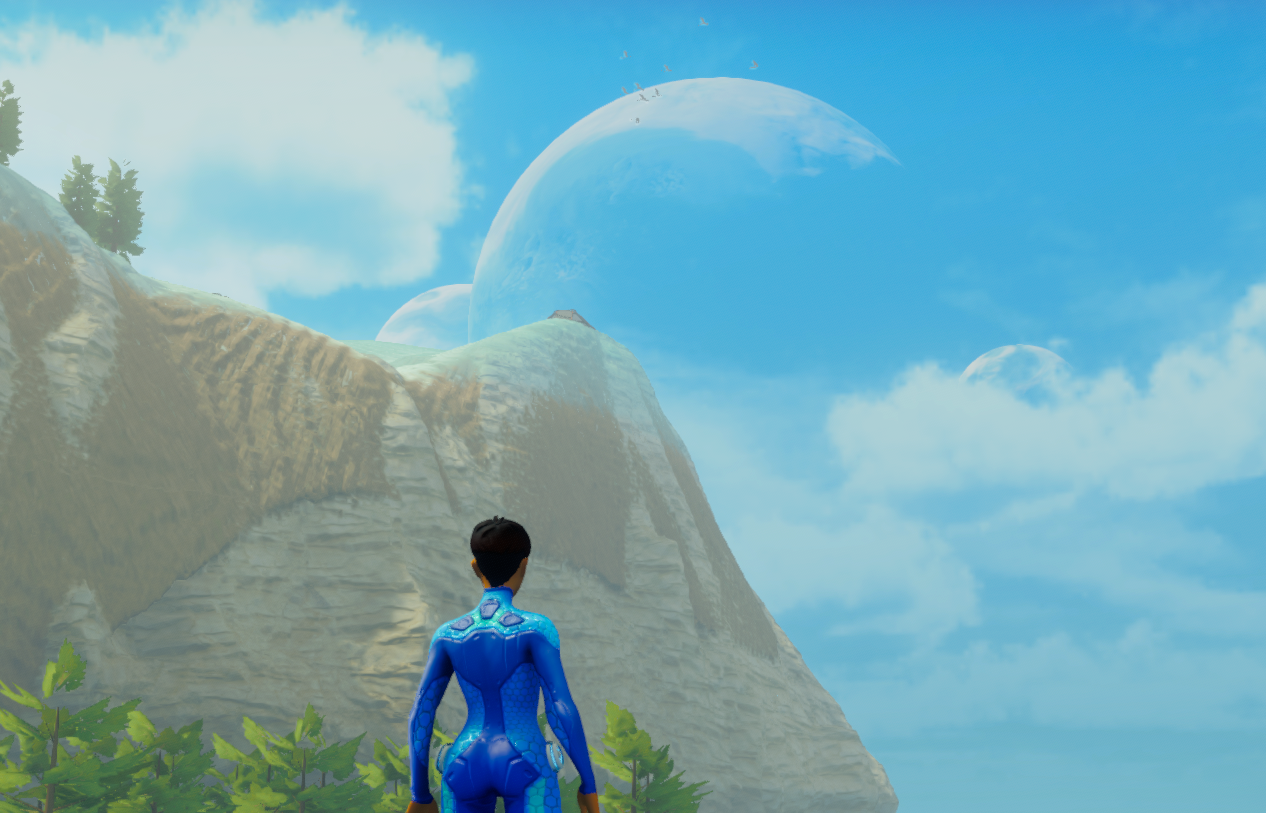
Signus: The biggest thing for me was accidentally taking off into flight right as the light changed from the sunset and I saw the horizon, light over the mountain, and people distantly moving. The world felt very visceral and traversable, very "Breath of the Wild"-like. Something you feel you can interact with."

Overall, it was a great start to our series of external playtests.
We'll be doing a follow-up to this first test soon, with a much greater volume of players so we can see where our breaking point is on the servers. Then next month we have a much more involved test for players to help us with and we're looking forward to it very much. More details on that soon!
Editors note: click here to sign up to playtest.
-
WHO IS STARS REACH FOR?

By Raph Koster
I think this may actually be the last of the posts outlining the high level goals of the game! And just in time too, because the very first Reachers are going to be landing on a planet in Alcance de las estrellas this weekend. That's right, it's time to start testing! If you're interested, be sure to go sign up, and join the Discord y wishlist on Steam while you're at it.
THIS IS A SANDBOX GAME
As you have maybe read from the other articles in the series, SR is very much a sandbox. That means that it is about living in another world, not just chasing XP pellets to complete gear sets. There is no single goal that a player can pursue, except perhaps to work together with other players to try to solve the large scale thematic problem the game presents.
In many ways, then, SR is more about play than it is about advancement. Advancement runs out or becomes an infinite treadmill; whereas if you get bored of playing one way, you can go play in another way and keep having fun.
This means that there isn't any one journey through Alcance de las estrellas. Instead, players choose their journeys. So how do we pick what features we will have?
In themepark games, you build one feature – player-vs-environment combat, usually – to a huge degree of depth, with a ton of progression and advancement in it. You then spare a thought for everything else, because progression is what holds the player.
Back in the day, we used to speak of "elder games," which meant features and subsystems that were not dependent on content treadmills: stuff like economic play, social play, PvP, and so on, which were much more about interaction with others.
Today, with themeparks having dominated the landscape, we instead speak of "endgame." Levelling up – the journey – has come to be thought of as the obstacle in the way to getting to "the real game," which is increasingly group raid coordination.
"End" isn't really a word you want sitting next to "world" though. Raids are another form of content treadmill, just they call for groups. There are gear sets and color coded items and all the same jazz that there is around the basic levelling game. Very much more about advancement than just play.
SOME THINGS TO DO
So what are some ways we want you to play? Well, here's a list from our early design documents:
- THE ADVENTURER
- Run across the geyser fields towards a crashed Old One ship, before the Cornucopia get there.
- THE TRANSLATOR
- Observe aliens speaking in strange glyphs; match them up, and crack the code of what they are saying.
- THE EXPLORER
- "Beep! Beep!" Audio signals help you find a soft spot in space to open a new wormhole.
- THE FARMER
- Plant red wheat under a violet sky; crossbreed strains to get a valuable healing variant.
- THE MEDIC
- One press of a button conjures a healing bubble around you as you call your party closer.
- THE XENOBIOLOGIST
- Sneak up on house-sized carnivorous bunnies and draw their blood; gotta sample 'em all.
- THE PILOT
- Collect crystals fallen from shattered asteroids and drag them in bags behind your ship.
- THE MINER
- Tunnel underground – the map is fully destructible. When the gold is gone, it's GONE.
In a game that is more about play than it is about advancement, we want to embrace the idea of horizontal progression: that you gain more abilities as you skill up, rather than just numbers going up. And these should give you tactical growth and the feeling of finding new ways to play over time.
So we would want a newbie to be able to blast away at space spiders or alien ice worms in an asteroid field. They should be able to explore a lost Old One laboratory hidden within the mountains of a volcanic planet. They should be able to try to tame a feral blunderhog and name it Fred, or take a mission to smuggle radioactive antigravium through a wormhole.
But an advanced player, someone who has been around the block, ought to be able to use their faction powers as a member of the Purity to call in an airstrike on a nest of the Corruption. They should be able to restore a dead world to life by importing creatures and materials from a distant world, or lead their guild to claiming a new planet, and perhaps become that planet's first governor. Maybe they make it a pirate den, or they build a powerful corporation by supplying the best spaceship engines in the Galaxy.
GETTING PRACTICAL ABOUT DEVELOPMENT TIME
Now, you might be thinking that sounds great, but also like we will ship in 2047. And some of that is because we are all so used to themepark progression. If you are designing a sandbox with many features, none of them have all the content progression treadmill that a themepark game devotes to PvE. Instead each one of those systems is small, in terms of implementation. Instead, we rely on the dynamics of the individual feature, and how it connects to other features, to provide the depth.
An example is that alien languages feature mentioned above. It's basically a codebreaking minigame. All our creatures "speak" their internal AI state over their heads, a lot like the Sims speak Simlish. But it's all encrypted, and it's encrypted differently on different planets.
It ties into the collection minigame (you have to collect the glyphs before you can assemble enough to crack the code). And it ties into the economy – once you crack the code, it generates economic value, because you can sell a translator module to a player who doesn't want to play this way but does want to know whether a creature is about to attack.
But the feature itself is just picking an encryption method. It's not that different from using code to generate Sudoku boards. If the core puzzle is solid, like Sudoku is, then there's going to be demand for lots of boards. If they have to be handcrafted, you're back on the content treadmill.
We strive for every feature to have these qualities: simple elegant rules, deep dynamics, and interconnection to other systems.
PICKING WHICH FEATURES TO MAKE
Even then, though, we can't make them all. We have our razors to help us cut our own ideas: what the game is about, what the vision items are. But we also have to think about it in terms of who will be playing.
We did a bunch of research to dig into what the demographics were for MMOs of various sorts – high fantasy ones, sci fi ones, games like Minecraft y Fortnite and many others. We looked at what ages the players tended to be. We needed to prove to ourselves that there was a market for the game we were contemplating. And we needed to understand why people chose to play those games.
We've worked with two different systems for that over the years. One of them, which we will be asking all our testers to use, is Solsten's. But when we started out, we used the Quantic Foundry model to think about what drives players.
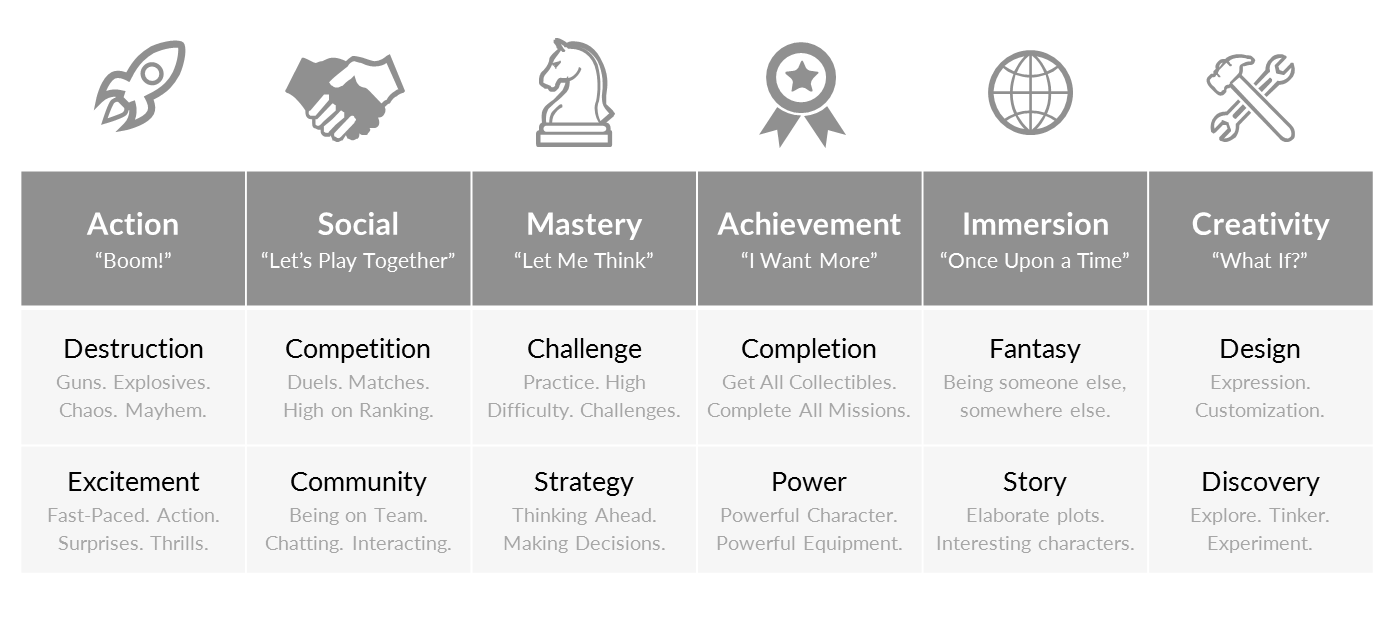
When we looked across these motivations and examined which ones were most common across ages and genders, some commonalities and differences popped up pretty quickly:
- "Completion" – meaning, collecting stuff and completing sets and task lists – is pretty much in everyone's top five.
- "Destruction" skews younger, and also male.
- "Fantasy," the motivation driven by immersion, is universally popular.
- "Story" doesn't pop as high as you would expect!
After some debate, we decided that for our game, we would treat these things as the core of our unique appeal:
- Community: The enjoyment of interacting and collaborating with other players.
- Fantasy: The desire to become someone else, somewhere else.
- Completion: The desire to complete every mission, get every collectible, and discover hidden things.
- Discovery: The desire to explore, tinker, and experiment with the game world.
- Design: The appeal of expression and deep customization.
And we decided that these items were not core. That doesn't mean we ignore them or have no features for these motivations, but it helps us define what we are not:
- Challenge: we are not Dark Souls. We want players to feel challenged, but we don't want to center the game on being the hardest experience ever.
- Story: we are not Uncharted. We want players to feel immersed, but we aren't going to have them sit back while we tell them a story.
- Power: we are not a game that someone wins and dominates everyone else, like say League of Legends. In fact, we are going to have a bunch of mechanics that cap people's power, in the name of serving community.
We then went through every feature we wanted to have in the game, and looked at which motivations they could serve. And we invented features and cut features until we had more things in the columns for the elements that are core, and fewer in the columns for the motivations that are not core.
TESTING ASSUMPTIONS
After all that, we made game for a few years. And relatively recently, we were able to go back and test again, to see if what we've made is getting close to that target, which has evolved as the market has. We put together descriptions of what the game has evolved into, and asked possible players to respond to what they heard.
We told them we were making a shared multiplayer world with many planets but a single universe. A world where you can play any role and learn any skills, with no class limitations. Where you can explore new planets, harvest resources, trade, craft, fight aliens, collaborate with others and transform for the worlds themselves.
We told them you could craft thousands of items both useful and decorative, and that someday you might get so good at it that visitors might come from far away to buy items with your brand on them.
That you would trade across the galaxy in a player-driven economy, where goods have varying prices in different locations. Buy low, sell high, smuggle or own a shop.
Sculpt the worlds, terraforming them and replanting, rerouting rivers and shaping them to the needs of you and your friends. Planets where every substance has unique properties, and creatures have needs and desires. A sophisticated ecological simulation where forests can catch fire and lakes can freeze over, and more.
Active combat with dodging and blocking and situational awareness, with an arcade style but also with options for people who have bad aim or no aim at all. And which players of different skill levels can still play together.
A social world where you can earn XP from helping each other or helping players. Where you can become a leader like the mayor of a town or governor of a planet, but can also play solo and only return to town when you need to buy and sell.
And we asked them to imagine exploring these worlds, traveling through wormholes to discover planets with unknown flora and fauna, unknown resources, and unknown mysteries.
What we got back was a lot of interest. In fact, exploring those living worlds scored through the roof! We also got back worries about griefing, about whether there would be a clear sense of which goals to pursue, and whether the game might be too grindy.
Most importantly, we found that there absolutely was a market for the game we are making. In fact, there's quite a big market.
We make decisions every day on how deep or detailed to make a feature, or whether we can afford to build it at all. There are plenty of cool ideas we have had which are pushed off to post-launch. We have to be realistic about what we can make.
But it feels great to know that you are making something that not just you feel excited about, but that there's a lot of other people who will be excited once they hear of it.
And that's why this weekend is so exciting too. Oh, those poor first Reachers will barely get to see anything! We expect to just crash the client over and over.
But with any luck, we will post a group selfie screenshot of the first strangers to join us on the limitless frontier of Stars Reach.
- THE ADVENTURER
-
WHAT STARS REACH IS, AND IS NOT

-
WHAT IS STARS REACH ABOUT?

por Raph Koster
It might be hard to believe now, but a couple of decades ago, plenty of designers didn't think that games could be art. They didn't think that there was any greater meaning, that it was enough if games were just fun and didn't have anything more to them.
These days, we have a lot more awareness that games can mean something, carry artistic statements, and can do while still being fun. In fact, one of the standard ways of thinking about game design now is to start with the idea that you want to evoke a particular experience for the player.
That calls for knowing what your game is about. This then cascades into knowing who your game is for, because no one game can be for everyone.
For years now, I have used a little vision exercise in order to help clarify thoughts around this issue. It consists of just four questions that you can ask of the game that help tie together the thematic side of the game with the game rules and mechanics.
Games where these two don't match often don't "feel right." You end up feeling like you are going through the motions in some storyline but really are just popping XP bags for loot.
WHAT IS THE GAME ABOUT (THEMATICALLY?)
After ruining our homeworlds, we are given a second chance to learn to live in harmony with one another and with the natural world as we venture forth into the galaxy.
In our lore, humans of various sorts are all the result of genetic engineering experiments conducted by the Old Ones, a powerful and long-vanished galactic civilization. But we now have done what you'd expect of humans (we're only human after all): we've made a mess. Whether it's global warming, peak oil, nuclear winter, or global pandemics, we have managed to ruin the planets from which we come.
This game is about different sorts of people learning to get along, and to learn how to steward what we have. Crucially, this is a lesson that the Old Ones themselves, for all their power, don't seem to have learned themselves.
It's all fine and dandy to say that this is what we want the game to be about, but that means that what the player can actually do has to line up to these goals. There have to be game systems that offer second chances, game systems that teach us to live in harmony with each other, and game systems that represent the natural world and how we interact with it. So we ask the next question:
HOW DOES THE PLAYER DO THAT (THEMATICALLY?)
Diverse groups of people with very different ways to play come together to build new societies, and grapple with the problems of building sustainable space settlements.
More features the game needs start to crystallize now. In order to learn to live in harmony, we need difference. The game has to supply multiple ways to play which sit at comparable levels of importance. It's not that it needs to appeal to everyone, but that it needs to support a spread of player types that help each other mutually survive.
Similarly, if we want to provide players with a laboratory about stewarding the world, then there need to be game mechanics that relate to that goal. The game itself needs to put the idea of sustainable settlements front and center. If we built a typical MMORPG where stuff repops infinitely, then this question would never even come up!
As you can see, game systems start to take shape from these questions, because the theme demands them. And already, they are forcing us to do things differently than most MMOs do.
So now let's ask the same questions but in a different way. Until now, we have been framing these within the fictional context, within the fantasy. What do the above answers turn into if we think of them in raw min-maxing numbers?
WHAT IS THE GAME ABOUT (MECHANICALLY?)
Players work together to maximize their economic standing and in-game investment without destroying the resource pools they draw from as they build up their in-game investment and social groups.
Now we are really into system design! This description is the same as the thematic one, but it's framed up in terms of goals and currencies and rules. We need a game where players are working through progression systems like usual, but collectively, not just on their own. That suggests some sort of system of collaborative progress, where the diverse types of players all are pushing towards similar meta-game goals.
There's a classic collaborative game mechanic that is perfectly suited to that, which is often called "barn-raising" in game design circles. Think of it as a collective goal that every player can contribute to individually, even while they pursue their own interests. This idea will serve as the backbone to our player government system: players in Alcance de las estrellas will work together to improve and progress their planets from wilderness to settlements and thence to cities and planetary governments.
The second half is far trickier. We want the players to engage in this activity but also have to be good stewards of the resource pools available. By this we mean the ores, the wood, the creatures they fight, and so on. This idea led us to the idea that planets must be capable of being destroyed – but also revived. That they should have health bars, so you can see how you are doing in managing them.
Players have to be able to see, at every moment, that what they do matters to the game environment. And from that powerful idea comes the entirety of the living world simulation that underlies Alcance de las estrellas.
So that's goals… what about the moment to moment? Well, we can once again ask the same question we did previously, but through a game rule lens rather than within the fiction:
HOW DOES THE PLAYER DO THAT (MECHANICALLY?)
Players form economic dependencies on each other's characters by advancing in diverse specializations and skills, all of which draw from the common exhaustible resource pools available in each zone, thereby creating a Tragedy of the Commons problem to navigate as a group.
We rely on players being self-interested! If we have every player out for themselves, and many ways to play, we can have all the ways to play depend on the resources in the world.
Then we can make the players loosely dependent on one another. Oh, not on specific individuals necessarily – we want to preserve the ability to play the game solo, as part of our pillar on accessibility. But economically, by having one playstyle rely on the existence of another playstyle.
This concept becomes the map of our player-driven economy. Combatants need someone out there who makes blasters. Crafters need someone out there who mines the materials for blasters. Miners need someone out there who maps these alien worlds and finds the deposits of rare minerals. And explorers need those combatants to keep them safely out of the bellies of giant carnivorous mushrooms.
If we instead made looting monsters the supplier of all economic value, then all economic power would flow from combat. Our thematic message would be lost. We want players to be thinking about the fact that it takes all sorts of people to build a society.
We have one special advantage in approaching things this way: The Tragedy of the Commons is a lie. The basic premise of the idea was that given human actors and a common resource, some asshole is always going to hog it all for themselves and ruin it for everyone else. And in fact, we have seen plenty of people who hear about our game and assume that griefers will inevitably win out here too, digging up every scrap of the landscape and ruining the planets for everyone else.
But… in reality, humans have successfully managed commons for millennia. In fact, a Nobel Prize was awarded to Elinor Ostrom for her thorough refutation of the concept.
 The only time that the Tragedy of the Commons comes true is when you accept the premise in the first place!
All that is needed is for the players to have the tools to collectively manage their space. We as a team definitely need to nail that aspect. And then, yeah, it gets hard, because trying to solve for everyone's competing needs and desires means a lot of compromising and negotiation and tough choices.
Well, in a game, negotiation and tough choices are called gameplay. We as designers need to give usted the tools to manage the space and prevent the one griefer from using up your commons. But after that, it's on you, the players, to figure out how to solve the larger problem of allocating the resources, deciding how much to build up your world at the price of losing your wilderness, and so on.
In the end, we hope that we see players land at many solutions for this, not one. We at Playable Worlds are not trying to be prescriptive about it. Instead, we want to see the thousand solutions this vast laboratory creates. And sure, some of those attempts will most assuredly end in strip-mined planets cooked down to the bare bedrock. That's okay. We have procedural, simulated worlds. If you wreck one, we can just generate another.
So yeah, Alcance de las estrellas is kind of a climate change metaphor. It's a political metaphor. Remember, it's about different sorts of people learning to get along, and to learn how to steward what we have.
Games can have greater meaning. And that meaning can matter well outside the game. If any one of those solutions you try out for fun on our infinite planets works out, we hope that maybe you can turn around and apply it to the real world.
Because we only get one of those.
-
LAS ESTRELLAS ALCANZAN LOS PILARES DEL JUEGO - TERCERA PARTE

Hello everyone, I'm back with the third chapter in our exploration of the pillars for our vision of Stars Reach. Today I'll be talking about the ones that get much more concrete about how the game works.
It's been great to see the discussion of these pillars on the official Discordia ¡y sitios MMO en línea!
The last big pillar starts out by describing the setting of the game. There's a lot of stuff piled into a single overstuffed sentence, I admit! But we wanted to capture all the key elements that make the galaxy of Stars Reach what it is.
Un divertido universo de ciencia ficción retro infinitamente explorable
El mundo es lo suficientemente sombrío; nuestro juego será visualmente atractivo, de colores brillantes, y tendrá un tono de optimismo y diversión. Tendrá cabida la melancolía, el misterio e incluso el miedo, pero lo hará dentro de una atmósfera general de posibilidades ilimitadas y diversión para el jugador. A la vuelta de cada esquina habrá nuevas vistas, nuevas cosas que descubrir y nuevos misterios que desentrañar. Se encontrarán (y se perderán) nuevos planetas, se descubrirán viejos secretos y se desarrollarán nuevos contenidos constantemente, permitiendo a los jugadores encontrar sus propios caminos en una galaxia de infinito potencial.¡Hay un montón de adjetivos ahí!
A lot of settings aren't worlds. They don't necessarily lend themselves to MMOs. A setting that is great for an MMO has to have variety, it has to have rich texture to it, and a degree of coherence and realism that a purely character-driven IP doesn't have. We owe Tolkien a big debt for setting the template for detailed worldbuilding in service of an epic story.But worldbuilding also has a "flavor" to it. The setting of Mad Max has thematic implications, and it'd be pretty darn weird to set the stories of, say, Studio Ghibli movies in a setting like that. (When they did their own post-apocalyptic thing, in Nausicaä, it was pretty different).
So let's focus first on the "retro sci-fantasy" bit. Why retro? Why call back to older rocket-and-rayguns stuff?
It isn't because we want to aim the game towards people old enough to remember that stuff from when they were growing up. And it's not because we want to aim towards kids (a lot of that iconography has aged downwards as it has been used by toys).
Rather, it's because we want to capture the spirit of that sort of sci-fi. It came from a period before, during, and post World War II where there was great enthusiasm about the power of science and the potential of humanity. Today, we see that retrofuturistic style used as a way to evoke the lost dreams we once had.Here are a few images from our "mood board" of artwork that reflect that sense of possibility… but also the danger that can be out there.


Images from left to right: "Atomic Avenue #1", art by Glen Orbik, Klaus Bürgle "Skyscrapers of the Future", Don Newton "Unknown Worlds of Science Fiction" special #1, 1970s
Tras el fin de la guerra, la ciencia ficción impresa se alejó de la sensación de optimismo (la SF mediática en la pantalla y en los cómics tardó un tiempo en ponerse al día). La Edad de Oro dio paso a la New Wave SF, mucho más pesimista sobre la humanidad y el futuro. Desde entonces, la ciencia ficción ha sido mucho más ambivalente con respecto a la tecnología. Incluso la principal ópera espacial de nuestro tiempo, La guerra de las galaxias, es cruda y sucia.
En última instancia, esto se relaciona con los temas centrales de nuestro juego y nuestra historia:Stars Reach es un juego sobre la esperanza y el optimismo. El mundo real ya es bastante sombrío. Queremos capturar esa sensación de posibilidad que estaba presente en la ciencia ficción de la Edad de Oro, que sensawunda ("sense of wonder") that it evoked.
That doesn't mean we have to shy away from serious themes or dark elements in the storylines. Necesitamos un mundo que pueda abarcar muchos tipos de historias. Pero debe presentarse con un espíritu general de optimismo.
El humor es un juego limpiopero nos inclinamos por el ingenio, la caricatura y el humor amable, como
opposed to cartoon, slapstick, or "easy" dad jokes. This is not a comedy game.
It's a game that takes things lightly.En lore really deserves its own blog post, because a lot of thought went into it. It's designed to provoke questions, and in keeping with the other pillars, it's meant to be easy to approach but offer depths that aren't apparent on first glance.
El juego tendrá una historia profunda.
Como dijo Tyrion al final de Juego de Tronos, las historias son lo que nos mantiene unidos. La identidad tribal está impulsada por la cultura, y la cultura está impulsada por las historias. Queremos crear una nueva tribu, los jugadores de nuestro juego. Podemos desplegar descubrimientos a lo largo del tiempo y crear el tipo de tapiz de complejidad que tienen las IP duraderas, una red de personajes y motivaciones que generan ficción de fans, cosplay y cosas por el estilo. Estas cosas son las que crean un fandom duradero.El tema central del juego es que las especies de nuestros jugadores han saqueado y destruido sus mundos natales a medida que se abrían camino hasta el borde de la civilización interestelar. Ahora, a estas especies se les ha dado una segunda oportunidad: una galaxia de mundos terraformados en los que construir su futuro.
¿Aprenderán de la lección del destino de sus diversos mundos natales? Para apoyar este tema, el juego debe recompensar el pastoreo responsable de estos planetas heredados y castigar su saqueo desconsiderado.
Among the things that we want to make sure the lore represents are an understanding of the grand sweep of history, themes of cross-cultural communication, how one deals with a Galaxy where a genocidal species basically swept thousands of planets clean, a feeling of uncovering a deep past… one of the central mysteries is, where did the Old Ones go and why did they leave? We don't know whether they annihilated themselves, decamped to greener pastures, or were exterminated by something even more terrifying.En definitiva, Stars Reach es alegre, optimista y colorista, pero capaz de abordar temas de peso y personajes fuertes. Se pretende proyectar esperanzay también es un juego que se hace guiños a sí mismo y a los tropos que utiliza. Si tuviera que resumirlo todo, sería we're going into space, and it's going to be awesome.
Now, if you've followed the reception to SR online, you probably already know that the graphics are a bit controversial. I'll restate again that we aren't at all done with the visual style. But I also won't lie, nailing an art style for the above is challenging. It ties back to whether the basic presentation is conveying that tone but also stretches to accommodate all the tonal variety we want in the lore and setting – and also reaches the audience we want.
One of the challenges with a hyperrealistic style is telling all the games apart. As rendering capability has increased, realism is starting to get… kind of boring. From a business standpoint, we need to stand out in the market. We also need to keep costs down, and our technology that allows us to stream content down on the fly works more cost-effectively with less load in terms of highly detailed textures. But lastly, high realism tends to tell broader audiences "this game is not for you." It signals to people that the game is complex, unapproachable, and often specifically chases away women players.
El juego será acogedor, divertido y hermoso.
Puede que lo atrevido atraiga al público principal, pero la mayoría de las cosas del mercado de masas son bastante soleadas y de colores brillantes. Si queremos fidelizar al público, necesitamos que la experiencia no sea estresante, que sea una vía de escape más que un calvario. Si queremos que la gente viva en el juego, tenemos que hacer que parezca habitable.
Recuerdo vívidamente dos grandes ejemplos de esto hace mucho tiempo: cuando salió World of Warcraft y cuando salió Dark Age of Camelot, ambos me parecieron inmediatamente más coloridos y acogedores que Everquest.
This is a hard line to walk. When we were doing early concept art, we actually developed a "realism to cartoon" scale, where we made sketches of a human avatar's head, in styles ranging from kids' cartoon through to realistic, and told ourselves, "never fall below a 7 on this scale." But it's a long way from sketches to in-game art, and we still have more work to do.Esto lleva a una serie de objetivos específicos para el estilo artístico del juego:
-
- Haz con la ciencia ficción oscura lo que World of Warcraft hizo con la fantasía oscura.
- Bright and colorful — a place you want to be.
- Alta belleza, no alta fidelidad: con esto queremos decir que es más importante que el entorno sea atractivo a que tenga texturas de altísima resolución y renderizado realista.
- It can be fun and even funny, but archetypes, not cartoons.
- Familiar tropes that serve as "anchors" for players' imagination, because much of the best visual design leans on things that are already familiar, then add a twist – rather than going all out weird with something that people can't relate to
- Strong silhouettes and iconic forms that can move across art styles.
- Influence from caricature and anime, for a contemporary look.
- Iterative development: we test our stuff and see that players respond.
You can be sure that as we continue to iterate the art style, we'll be doing a lot of that last one with you all!
Our last pillar is all about gameplay.
The game will constantly generate new content.
It is expensive to make content. We want to enable players to create as much as possible, and we want to enable the game to create as much as it can as well. It has to be constant, because we want players to always want to learn about what's going on. We want them to feel like it's something that stays fresh and evolves and makes them want to check in regularly.Now, this doesn't exclude content we create. But that's sort of the default assumption these days in design: that the designers will populate all the content. Designing for the game itself to drive emergence doesn't mean that we abdicate our responsibility to create engaging content. But it does mean taking a look at every single system to ensure that it isn't reliant on that.
From this emerged a whole bunch of pretty specific principles which shaped the game design very powerfully.
We decided that Collection, Crafting, Settlement, and Combat were the core activities of our game. This wasn't arbitrary, either. It was driven by the audience we are after, which is a large one, and a diverse one in the sense that it is made up of players with varied gameplay preferences but who all like existing in a sandbox together where they interact.
This then also implied two big things:-
- The entire game economy is player-driven.
- Combat is opt-in, and not at the core of the game loop.
To many players, these two things may feel like a marginalization of combat. The fact is that combat usually marginalizes everything else, so every once in a while turnabout is fair play! I was wondering online a while back on Reddit, "when exactly did we start calling everything else you do in an MMO 'life skills?'" The default current of MMO design usually puts combat at the center, and relegates other ways to play to "side games."
Everyone always feels like their preferred way to play should be dominant, and can even get pretty resentful of seeing other ways to play present. But there are good reasons to interweave everyone more.
We want to put Community First because MMOs are about other people. I often describe virtual worlds as "be someone you aren't, somewhere that you can't be, with others." That's the heart of the unique offering of MMOs. You can get individual bits of that sentence elsewhere, but there's something magical that happens when you get all three from one experience. And it leads to a few more goals:
-
- Player-driven economy fostering social ties – because each different play to play the game can be related to the others via the goods and services that playstyle outputs.
- Similarly, having multiple guild types and multiple guild membership also helps foster strong ties. Basically, a common pattern that we see (and a common mistake, we've come to realize) is trying to make human relationships one-size-fits-all.
- "Increase communication bandwidth." Chat, emote animations, etc, should be very important, because the higher the bandwidth for emotion and humanity to pass through the game, the more likely players are to behave, because it's easier to recognize the people on the other side of the wire as being people like yourself.
Of course, that means you have to recognize that it takes all sorts of people playing in their own ways to build a world. That sort of diverse playerbase is very different from chasing a super narrow audience of specialists in just one way to play. The bet we are making is that the range of playstyles in one game will appeal to people who get tired of one-note play. If you get bored of one way to play, you can go try another.
We think of that range of play in a couple of ways. We have to support diverse sorts of players – different age ranges, genders (a lot of games chase away demographics through their choice of art style, as mentioned above), ethnicities, and so on. We also need to support different playstyles; we have used both Quantic Foundry y Solsten models to think about our players at different stages of the game's development.
And lastly, we need to level the playing field some between new players and old pros. The power accumulation curve of most MMOs results in friends being unable to play together as soon as one of the members has more or less time to play than the others. MMOs have long recognized this problem and built design hacks into the system that basically "undo" you advancement when playing in mixed-level situations. The first one of these was "sidekicking" in City of Heroes in 2004, but nowadays we have level scaling and other approaches, all of which are fundamentally about ignoring the level system that the game is designed around.
Since we favor horizontal progression, where instead of "numbers go up" we have "number of commands goes up," we can avoid this issue. In our game, your hit points won't go up noticeably. And you will do more damage not because you leveled up or your gear got better, but because you compounded tactics together that you unlocked with skills.
So, that (finally) finishes the series on key pillars for the game. I hope you found it an interesting glimpse behind the curtain on how we try to wrangle a huge project like Stars Reach into something that a team can wrap their head around.
That's it for this week, but I'll see you around the Discordia, or Reddit, or wherever your favorite theorycrafting community is, and if you want to talk about these pillars, I'm always up for it!
-
-
LAS ESTRELLAS ALCANZAN LOS PILARES DEL JUEGO, SEGUNDA PARTE

por Raph Koster
Hola a todos,
I'm back to talk more about our design pillars for Alcance de las estrellas. La última vez describí un MMO como un lugar virtual en el que ponemos juegos, más que como un juego. También prometí que hoy hablaría de los principios que animan los juegos -¡la diversión! - que esperamos ofrecer.
Just like the last set, these are organized into a big statement, with three consequences of the statement. What I didn't talk about last time was that even the three consequences break apart into a bunch of even smaller ones, which become more like design rules that we try to follow as we do our work.
Esta semana merece un pequeño prefacio.
Look, we all know that the audience feels like MMOs haven't really progressed much. A lot of the action in online games has shifted over to looter-shooters, survival crafting, and the like. These genres are children of MMOs, streamlined down to make them more accessible in a bunch of ways.
Los MMO siempre han sido grandes bestias difíciles de manejar. Muchos bucles de juego, mucho contenido, en un mundo enorme y extenso que podía resultar poco amigable y difícil de entender. Por eso, cuando llegó World of Warcraft y te llevaba de la mano en cada paso del proceso de subida de nivel, fue toda una revelación. Acabó con los días de confusión total, a costa de una libertad total.
Ese camino siguió perfeccionándose, pero its end destination isn't a traditional world anymore. It's more like a looter-shooter. Destino 2después de todo, se parece mucho a un MMO al que se le ha quitado la parte del mundo.
Ironically, feeling more like a world has been flourishing in single-player games. Whether it's Anillo Elden o los recientes títulos de Zelda, existe esta tendencia hacia los mundos abiertos que se sienten más vivos. Y Breath of the Wilden particular, nos demostró a todos que se puede tener una experiencia de mundo sandbox muy accesible si se diseñan correctamente la interfaz y la jugabilidad.
This matters because I've always felt that el juego en el arenero es más popular que la caza de orcos, despite the conventional wisdom that sandbox games are more niche. Oh, it's not to say that orc-slaying isn't awesome and fun. Of course it is. But I think we all know that decorating a house, or running a business, or engaging in carpentry or cooking or other crafting, is just a more widespread human activity. Sandboxy gameplay by nature offers more than kill, kill, kill, and should broaden the audience. If only it weren't so intimidating and confusing.
Lo que nos lleva al pilar central:
La facilidad de Nintendo se une a la profundidad de los MMO sandbox
El juego ofrecerá una profunda simulación y libertad para que los jugadores tomen sus propias decisiones sobre cómo jugar. Pero el juego limitará la complejidad de su interfaz a lo que pueda conseguirse con un mando o una pantalla táctil. Optará por la elegancia en lugar de la complejidad visual, y utilizará interfaces por capas para que los jugadores nunca tengan demasiadas opciones a la vez. Dado el deseo de facilidad y accesibilidad, al final nos esforzaremos por tener clientes en muchos dispositivos.
A lot of gamers probably worry that having things be easy on the surface means that the depth won't be there. But these ideas aren't mutually incompatible. One of the oldest statements about games is that they should be "easy to learn, hard to master," after all. Among some gamers, there's even a point of pride in dealing with frankly overcomplex and intimidating controls, a sort of sunk cost fallacy of "well, I learned it so it must be good."
Pero si queremos sacar a los MMO del atolladero en el que se encuentran, no podemos mirar atrás a las convenciones de la interfaz del pasado, a la complejidad que se traduce en pantallas con más botones que otras personas. Tenemos que hacer que los MMO sean algo a lo que los jugadores que no son de MMO estén dispuestos a dar una oportunidad. Todas las bondades que esperan los jugadores veteranos de MMO pueden seguir estando ahí.
Así que si pensamos en esta gran afirmación central, llegamos a tres partes que implica. Ahora bien, recordemos que tenemos que pensar en esto en términos no sólo de lo que ofrece diversión al jugador, sino también de lo que constituye un negocio sostenible. Por suerte, ¡diversión sostenida es igual a negocio sostenible!
"The game will be deep: a set of proven game mechanics brought together in one universe."
The core premise is that we can marry ease of use to depth. Why? Because ease of use maximizes audience, and depth maximizes retention. We will make our money by holding people over the long run. We don't need to be the most popular game in the world, we need to "maximize the area under the curve," which means that retention wins over the long haul. If we can become a hobby for people, we can continue to drive revenue over years (and not just from the game, but from ancillary extensions of the IP as well).
So much of what has gone wrong with game services has been the trend towards trying to maximize revenue. We aren't after that goal; en cambio, queremos maximizar el amor de los jugadores por el juego. Un gran juego puede convertirse en un pasatiempo que dure muchos años. Por eso Ultima Online está a punto de cumplir 27 años y cuenta con varias generaciones de jugadores.
And if we can keep driving revenue, we can keep updating the game, keeping it current, and giving people joy. And that's what it's all about, isn't it?
¿Qué entendemos por mecánica probada? Bueno, he mencionado que las reglas de diseño surgen de estas viñetas. Algunas de las que tenemos basadas en este pilar incluyen
- Los sistemas sencillos pueden soportar un juego profundo; piense en el Go o el ajedrez.
- Los MMO requieren profundidad, una jugabilidad variada, un universo que explorar y dominar.
- Our dev team "plays jazz": We experiment, iterate, and find the fun.
- If something doesn't sing, if a system isn't fun — fix or or kill it.
We look back at other games, particularly MMOs, constantly, looking for the best version of a given system. We aren't reinventing every wheel here; we picked our big battles like our living world simulation, and made those our core innovations. But there are so many great games out there that you can't experience with others in an MMO. Si podemos llevar esas experiencias a un entorno compartido, la sensación cambia radicalmente.
En otras palabras, ¿por qué no tener la mejor construcción de juegos como Los Sims y también cosas más actuales como Enshrouded? ¿Por qué no echar un vistazo a los juegos de combate de más éxito y robar ideas? Al fin y al cabo, el diseño de los juegos se basa en otros juegos.
La parte más difícil de este diseño es mantenerlo apretado. Mucha gente ha comentado que nuestra visión parece muy audaz y ambiciosa. La única forma de construirlo es que los componentes sean pequeños y elegantes. Tienen que ser juegos de reglas más parecidos al Go. A menudo les digo a los miembros del equipo de diseño que van a tener que convencerme sobre cualquier sistema de juego que utilice más de tres o cuatro reglas y tres o cuatro variables. Se pueden tener muchas datos in a system like that, without making the coding and balance a nightmare. (A deck of cards only has three variables: 13 numbers, 4 suits, and 2 colors. That's it, and yet look at the depth of all the card games made with that small set!)
Probably the best example of that in what you have seen so far is the living world simulation itself, which is built out of surprisingly few rules (that's a big part of how we can scale it to this size!). Stuff in the world knows how to flow and fall, stick, change state, and react to other stuff. That's pretty much it. But from that we get a very large number of interactions and a ton of depth.
Los controles y las interfaces serán intuitivos, sencillos y familiares.
Familiar is important because it means that users don't have a huge barrier to entry when they first show up. Intuitive and simple is important because it means both users who are coming to us for the first time, and users who are returning after an absence, don't have a huge learning curve and barrier to entry. It maximizes the possible audience. It also lets us go to multiple clients more easily.
A menudo intento distinguir entre complejidad y complicación. Hay mucha complejidad disponibles en la baraja mencionada. Pero la forma básica de una baraja no es complicado. El ajedrez sólo tiene seis tipos de piezas. El Go tiene una.
I worry, sometimes, that audiences won't understand that something that looks simple might be deep. I've seen comments from folks in our (wonderful!) Comunidad de discordia that "hey, I don't see hotbars with a ton of buttons on the screen, so it doesn't signal MMO to me." But lo que hace a un MMO no es el tamaño de la barra de acceso directo. Lo que hace a un MMO son las actividades que puedes realizar en un lugar virtual.
Now, you still want familiarity, of course. That's what eases the player in. Some of the bullet points we have as design rules here include:
- Reducir al mínimo la curva de aprendizaje; facilitar que los jugadores se lancen a jugar.
- You have two hands, so you have a few tools at a time. That's your current "class."
- Less bars: use techniques like BOTW's fatigue meter.
- Haga todo lo posible en el mundo real; dialogue sólo cuando sea necesario.
- La interfaz de usuario debe ser suave como la mantequilla.
El segundo se refiere un poco a cómo gestionamos la progresión y las habilidades de los jugadores... Te permitimos aprender todo tipo de cosas en el juego. Pero usas esas habilidades a través de herramientas, y sólo puedes tener un número limitado de ellas contigo al mismo tiempo. Así que construyes una barra de acceso directo a partir de la forma en que quieres jugar en una sesión determinada. Si quieres cambiarla, lo único que tienes que hacer es ir a casa y cambiar las herramientas que llevas en tu equipo.
Esto último es más bien un objetivo a largo plazo, y algo que me preocupa un poco que los jugadores de base miren por encima del hombro, ¡sinceramente!
Admitiremos clientes variados para que los jugadores puedan jugar en cualquier dispositivo que elijan.
…and that matters because we see particularly younger folks moving readily across computing devices. Mobile devices dominate gaming time, and are the gateway computing device. We want to be there where users reach for us, and the thing most users most often reach for is their phone. This lets us have more frequent touch points, which keeps users in the orbit of the game. Regular engagement is the biggest predictor of both retention and revenue.
Sé que muchos jugadores desprecian todo lo relacionado con los móviles, pensando que debe significar simplista o diseñado para extraer el máximo de dólares. Pero nosotros pensamos de otra manera: si algo es una afición querida, queremos tenerlo al alcance de la mano en cualquier momento. Y un teléfono es algo que probablemente siempre llevas contigo.
Pienso en los dispositivos como ventanas al mundo que estamos construyendo en la nube para todos ustedes. They're just windows of varying sizes and control schemes. And someday, I want you to be able to use whatever window you have handy. Oh, you may not be able to do everything that way. Some sorts of gameplay will always work better with one control scheme versus another, with a larger screen than a small one.
So we're starting PC first, for sure. But already a pretty substantial chunk of PC gaming is happening on Steam Decks and similar devices, and the use of controllers for controlling PC games has gotten to be almost mandatory. So designing for a world like that makes sense if you want to be more futureproof.
All of these pillars end up being about the same things, really. Make it easy for players to participate, but have real depth and complexity inside what seems like a simpler wrapper. All too often surface complication tricks us into thinking there's real depth in there, when really there's a lot of stats that boil down to mostly the same thing. Queremos construir un juego que tenga la verdadera profundidad y complejidad que surge de la combinación de cosas sencillas de formas inesperadas.
As to how we get that complexity, well… that will have to be next week's post. In the meantime, I'd definitely enjoy it if you stopped by the Discordiadonde mantenemos conversaciones con el SR ¡comunidad en torno a estos temas!
-
LAS ESTRELLAS ALCANZAN LOS PILARES DEL JUEGO - PRIMERA PARTE
por Raph Koster
Hola a todos,
I'm kicking off a little series of posts here on what our core game pillars are. Estas son las filosofías definitorias que animan todo en el diseño del juego. Nos dicen qué es el juego y qué no es el juego.
Cuando trabajamos en el diseño, recordamos constantemente estos principios básicos y los comparamos con nuestro trabajo. Queremos asegurarnos de que nos mantenemos fieles a las ideas que constituyen el núcleo del juego, porque todos los sistemas se derivan de ellas.
We didn't just come up with these out of the blue. These were based on doing market research, looking at what things players have been asking for, what things have been missing from MMOs for a long time, and so on.
También se basaba en sueños sobre lo que es posible ahora, con la tecnología actual. Creemos que los MMO se han estancado. Cuando yo trabajaba en Ultima Online soñábamos con mundos totalmente simulados, mundos que pudieran reaccionar a las acciones de los jugadores. En lugar de eso, los desarrolladores tendemos a crear atracciones de parque temático para los jugadores, pequeñas experiencias enlatadas por las que corren, en lugar de mundos alternativos.
So our first pillar to talk about is therefore this one. Before you read it I should say, it's obviously aspirational, all these pillars are!
El mundo en línea más vivo jamás creado
La forma en que nos describimos este pilar fue la siguiente, que en realidad está cortada y pegada directamente de la wiki de desarrollo interno. De hecho, esta es una de las piezas más antiguas de la documentación de diseño en todo el proyecto, ¡y es anterior a cualquier código escrito!
La simulación económica y medioambiental será el sustrato subyacente del juego, y los jugadores podrán elegir entre una amplia gama de formas de interactuar con los sistemas. Los jugadores podrán hacer en el juego cosas que siempre han esperado: dejar caer objetos, prender fuego a los árboles y cavar agujeros en el suelo. Descubrirán que el mundo hace cosas que esperaban: el viento puede soplar a tu alrededor, puedes resbalar por una pendiente pronunciada y la nieve puede amontonarse y enterrar cosas. Por último, y lo más importante, los personajes de los jugadores estarán interconectados en una sociedad viva, con la intención de formar comunidades fuertes.
Como puede ver, we intentionally defined "alive" as including what jugadores no sólo lo que hace el mundo. Si lo que hacen los jugadores afecta al mundo, y lo que hacen importa a entre síentonces se refuerza la sensación de que es un lugar alternativo.
In fact, you've heard us talk about our living world simulation tech a lot, but the fact is that the economic simulation that players are participants in is igual de importante, even though it's not nearly as visually cool.
A partir de este pilar de alto nivel, tenemos tres objetivos específicos a los que aspirar.
"The game will run off simulation."
Todos los mejores juguetes se mueven por simulación. Lego. Hot Wheels. Minecraft. Los Sims. Having building blocks that interact with each other in magical ways is what encourages a playful attitude to the game, which then leads to players surprising us with emergence. (But we won't be demasiado sorprendido, porque vamos a diseñar para esa aparición desde el principio). Esto da lugar a nuevas formas de jugar, nuevas formas de que el mundo del juego crezca y florezca, y así sucesivamente.
The tension between simulation and what I call "stagecraft" has a very long history in online game design in particular. If you use stagecraft, you are basically "faking" reality, in ways that help guide players. This is often really necessary – it's very easy for players to feel like they are confused or lack guidance.
On the other hand, simulation, and consistent underlying rules, is where you get emergent gameplay from. This is both a blessing and a curse – it's hard to predict the outcomes, and they could be good or bad for fun! So when you design in a simulationist way, you have to always temper your approach and think of how to end up with divertido en lugar de realistas. El realismo no suele ser muy divertido.
Our core simulation is, of course, the environment. One of the questions that always comes up when we talk about our game with other developers is "what gameplay impact does that feature have?" And it's the derecha pregunta.
We don't want to just have different types of dirt for no reason. They have to matter to a game system – such as farming. If we have different sorts of rock, the differences should matter – to crafting, say. If you can melt that rock, that can't just be a cool gimmick with no purpose. It has to matter in terms of giving players fun things to do. Maybe you can melt stuff to the point where its transmogrifies into something else! Maybe you can melt holes in front of creatures so they fall in and die during combat!
The point being, having a simulation that exists but doesn't provide gameplay is kind of pointless. We're not building a science experiment, we are building a game.
"The game will be a true persistent state world."
You can't have real history without persistence. You can't have pride of place. You can't tie players into the world unless there is a world to tie them into. This is what allows the crazy experiment players made to stick around and be experienced by others. This is what drives returns out of nostalgia. This is what leaves traces of lore to be found.
By itself, this is a technical requirement. Not a small one, either! But it's really about human behavior.
Worlds that are more theme parks don't have history within the game. Oh, sometimes developers have done things like destroy a zone as part of an event, or have expansions alter the map that already exists. But small things don't change day to day, and it means that players kind of just move through the environment.
Cuando exploramos el mundo real, gran parte de lo que nos gusta encontrar son las huellas de quienes nos precedieron. Cuando en el mundo real hablamos de nuestros legados, nos referimos a las cosas que dejamos atrás para que otros las experimenten algún día cuando nosotros ya no estemos. These are profoundly human feelings that games aren't tapping into.
Y sí, también crean diversión.
The history of online worlds is partly the story of slowly adding more and more persistence to the experience. In the earliest text based worlds, you only saved the state of your character. The world fully reset around you every once in a while. Eventually, this evolved into resetting each zone independently. I remember when the innovation of having repops per mob came along and it felt like the world had taken a big step forward is realism! ("Mob" is the term of art for "mobile object," so think "monster or NPC").
Similarly, we went from saving just what you carried (and often not all of it) to saving your corpse if you died, and then the contents of bank accounts, and so on. The definition of "your character state" got bigger over time.
These days, the largest way in which players tend to be able to modify the world is using a player housing system. But so many games tuck that away into an alternate dimension, basically, so that players don't leave a trace. It's really just a big inventory bag that looks like a house.
That's really not all that human structures are, despite our habit of hoarding stuff. The monuments we leave behind are often public works, plazas and pyramids, theaters and halls of government.
And yeah, it's okay if the works of players past, like those of Ozymandias, turn to ruins someday.
But it's really the last one of these three where it all comes together.
As an MMO, we are a live service game, and that means that we live and die based on people coming back, making the game their hobby for extended periods of time. That's just a survival thing, for any MMO. We have to design within business realities, not just for fun factor.
Luckily, the two can often coincide. But it means a big ol' block of text! Remember, what you are about to read may sound like it's cynical business talk, but it's not.
"The game will be driven by player community and interdependence."
Retention is driven by community above all. Social ties in the game are the biggest predictor of retention. Particularly now that streamers and the like are the biggest social hubs, replacing guild leaders, it's incredibly important that we tie users to us, not to the streamer or celebrity.
En World of Warcraft lanzada, se empeñaron en robar a todos los líderes de gremios de alto nivel de EverQuest. Similarly, we don't want someone to be able to steal our audience by persuading streamers away from our game. We have designed this game so that people don't identify with only one social hub. That's why we have systems such as multiple guild membership that drive loyalty to multiple hubs.
People can be very important to your life even if they aren't close friends. Think of that plumber or electrician you rely on, even though you don't really know them. Those relationships are called "weak tie" connections, and despite the name, they actually make the social network stronger, reducing the dependency on central hub people. When people depend on you, you are less likely to leave.
Por último, estamos invirtiendo mucho en ciudades de jugadores, gobiernos planetarios, viviendas y otros tipos de permanencia. Son cosas que no puedes llevarte contigo si te marchas, y eso hace que sea menos probable que quieras irte. Al limitar el espacio por planeta, evitamos que un centro social determinado crezca demasiado y, por tanto, se haga demasiado poderoso.
Estos lazos importan porque son conexiones humanas reales. It's that healer you really trust in a fight to have your back. It's that crafter who makes the best armor, the one you trust the most. It's the person who shares similar play hours to you, and you come to know each other as friends. These are real ties, not fake ones. Real relationships.
A la gente le cuesta trabajo forjar este tipo de amistades y, en el mundo real, ocurre gradualmente, a medida que las personas llegan a confiar unas en otras. ¿Cómo se construye la confianza? Suele empezar con formas de intercambio: un servicio prestado, un pago realizado. Pero de ahí se pasa a favores y regalos, y finalmente a confidencias y sentimientos compartidos.
This is why the player economy, and people needing each other for varying goods and services, is so important. It's an on-ramp to friendship.
Así que, aunque nuestra necesidad de que los jugadores se comprometan con el juego durante mucho tiempo es una necesidad empresarial, también responde a una necesidad muy real de los jugadores: la conexión humana. Y, en realidad, eso ha estado en el corazón del género MMO todo el tiempo. Es lo que distingue a los MMO de otros tipos de juegos. Los MMO se centran en las otras personas del mundoal fin y al cabo. Son lugares virtuales en los que se nos ocurren juegos.
But this is plenty long, so I'll talk more about those games next time!
-
STARS REACH EN LA TIENDA DE STEAM
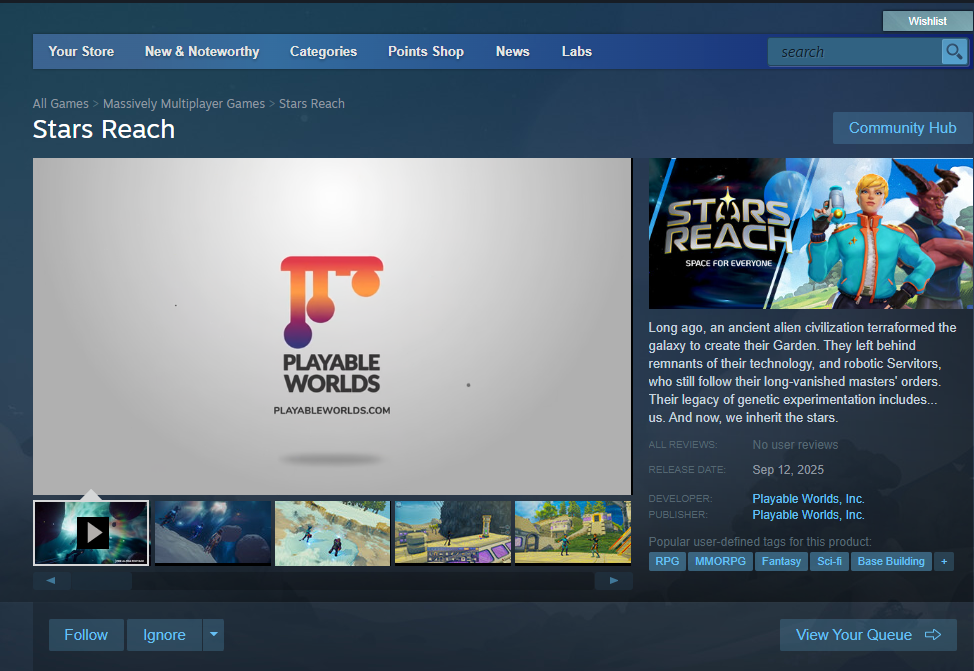
Steam ha añadido una página Coming Soon para Alcance de las estrellas a la tienda de Steam.
Además de describir el juego y mostrar 3 vídeos y un conjunto de capturas de pantalla, la página también incluye un botón de lista de deseos.
Lista de deseos Alcance de las estrellas en Steam para que el algoritmo de búsqueda recomiende el juego a más gente. Te agradecemos tu ayuda.
-
PLAYABLE WORLDS DESVELA SU PRIMER JUEGO: STARS REACH

Playable Worlds ha anunciado su primer título, Alcance de las estrellas, a massively multiplayer sandbox, exploration, and alternate-life game. Playable Worlds also released three videos that focus on early pre-Alpha game play, Raph's creative vision, and Raph and the development team took questions from the community on what players can expect.
Stars Reach es un universo inteligente, vivo y totalmente modificable que ofrece a los jugadores una oportunidad única de experimentar la vida en mundos lejanos. Stars Reach da la bienvenida a jugadores de todos los niveles de habilidad, experiencia de juego y compromisos de tiempo para explorar nuevos mundos, hacer nuevos amigos y descubrir nuevas posibilidades juntos.
Actualmente en fase pre-alfa, aún no se ha anunciado una fecha de lanzamiento.
-
REDDIT ANUNCIA EL AMA DE RAPH KOSTER PREVISTO PARA EL 28 DE JUNIO DE 2024

El subreddit /r/MMORPG, que cuenta con 258.000 miembros, recibirá a Raph a las 10am PST/1pm EST/7pm CEST del viernes 28 de junio de 2024. El AMA o Ask Me Anything es una respetada tradición de reddit. Ven preparado para leer preguntas y respuestas en directo o incluso para hacer tus propias preguntas sobre juegos nuevos y antiguos, libros, etc.
Visite el subreddit para obtener información adicional aquí https://www.reddit.com/r/MMORPG/.
Alcance de las estrellasstarsreachteam2024-05-30T13:05:17-07:00